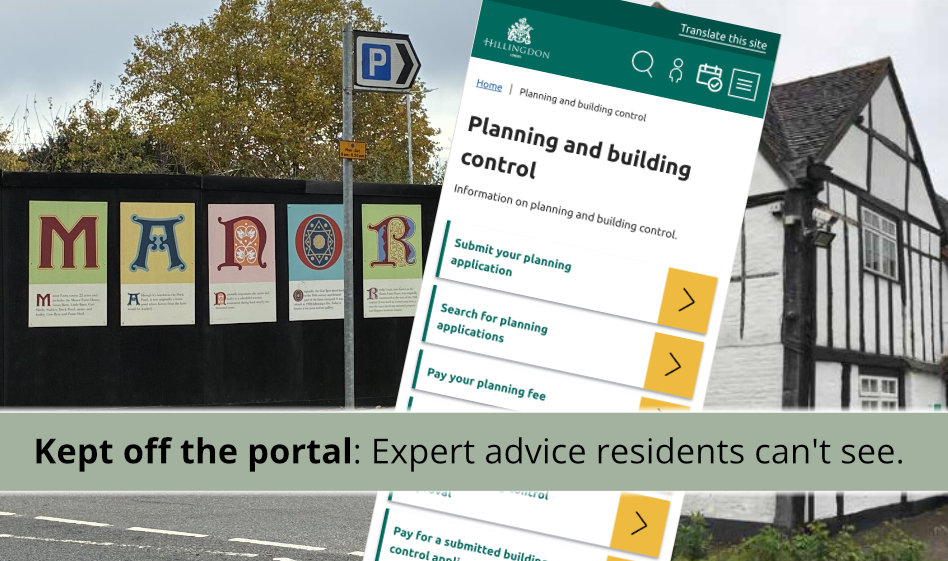
Hillingdon Council is failing to publish vital expert advice on its public planning portal. Across several live local applications, formal consultation responses from statutory heritage and archaeology experts have been kept off the public record, with officers stating they are only provided “upon request”. The Ruislip Residents’ Association has submitted a formal report to the Council’s Director of Planning, calling for an immediate end to this practice and demanding that the public planning file is made genuinely accessible to residents before any further decisions are taken.
When planning applications involve heritage sites, conservation areas, archaeology, or major local development, residents should be able to see the expert responses before decisions are made.
That should be a basic part of an open planning system.
The Ruislip Residents’ Association has written to Hillingdon Council after identifying a concerning pattern across several live local planning applications: formal responses from heritage and archaeology consultees do not appear to have been published on the Council’s public planning portal.
These include responses from bodies such as Historic England, the Greater London Archaeology Advisory Service (GLAAS) and the London & Middlesex Archaeological Society (LAMAS).
The issue is simple. If expert advice has been received by the Council and forms part of the planning file, residents should not have to know it exists before asking to see it. It should be available on the planning portal while the application is still live and before any decision is made.
The report has been sent to Hillingdon’s Director of Planning. Given the wider implications for the borough’s planning system, it has also been copied to Ruislip ward councillors and to Cllr Nick Denys, who is not only an Eastcote ward councillor but is now also the Cabinet Member for Planning, Housing & Property.
This is not about whether residents support or oppose any single application. It is about whether the public planning file is complete, accessible and transparent before decisions are made.
THE LEGAL ISSUE: ARTICLE 40
A transparent planning process relies on a simple principle: residents, councillors, applicants and local organisations should be able to see the same relevant information.
The RRA’s report sets out the position under Article 40 of the Town and Country Planning (Development Management Procedure) (England) Order 2015.
That provision requires local planning authorities to make available on the planning register:
- the application
- plans and supporting documents
- “any representations made to the authority in relation to the application”
The RRA’s position is that statutory consultee responses are formal representations made to the planning authority. They should therefore be publicly accessible before the application is determined.
In plain English: if Historic England or GLAAS sends Hillingdon Council a response about a live planning application, residents should be able to read it on the planning portal before the Council makes its decision. A later summary in an officer report is not the same as residents being able to see the original expert response during the consultation and decision-making process.
HILLINGDON’S ANSWER: “WE DO NOT ROUTINELY PUBLISH”
When the RRA raised the absence of these documents on live local files, Hillingdon’s planning management confirmed its current approach.
On 16 April, a planning officer stated:
“The Council does not routinely publish consultation responses on the planning portal. However, such documents form part of the public planning file and can be made available upon request.”
That answer is revealing. The Council accepts that these documents form part of the public planning file. But its position appears to be that they do not routinely need to appear on the public planning portal.
The RRA does not accept that this complies with the transparency required by Article 40. Residents cannot request documents they do not know exist. Nor should they have to conduct a private investigation to obtain statutory material that should be part of the public planning record.
A later response on The Barn Hotel application made the position even clearer:
“The LPA do not publish consultee comments and that includes statutory consultee comments.”
That is the practice the RRA is challenging.
In a previous investigation, the RRA bypassed the planning portal to reveal that heritage experts are sounding major alarms over the St Martins Approach car park development (Ref: 49461/APP/2025/3009). Both Historic England and the Greater London Archaeology Advisory Service (GLAAS) have explicitly warned that because the site sits within the Ruislip Village Conservation Area, full archaeological trial trenching and digs must take place before any planning decision is made, not left until afterwards.
Despite the significance of these expert warnings, the Council kept both letters off the public file. You can read our initial coverage, explore the specific risks to the Ruislip Motte and Bailey, and download the hidden expert reports in full here: Digs Before Determination
WHAT WE FOUND IN RUISLIP
The RRA’s report reviews a small snapshot of Ruislip applications. These include:
- St Martins Approach Car Park — Ref: 49461/APP/2025/3009
- The Barn Hotel — Ref: 7969/APP/2024/2451 and 2452
- 2 Arlington Drive — Ref: 74323/APP/2026/478
- 9 Eastcote Road, the old cab site — Ref: 41912/APP/2018/792
In several cases, the RRA has obtained consultee responses directly from Historic England, GLAAS or LAMAS, or through information requests. Yet the relevant documents were not visible on Hillingdon’s public planning portal.
At St Martins Approach, the RRA obtained the GLAAS response and the LAMAS submission directly from those bodies. The Historic England response was later obtained through Freedom of Information request. The RRA’s report notes those documents raised significant archaeological concerns, explicitly stressing that actual archaeological digs and investigations must take place before any planning decision is made, not left until afterwards. None of those documents appeared on the Hillingdon portal.
At The Barn Hotel, the RRA obtained a GLAAS consultation response from October 2024. Again, the concern is that this response was not published on the portal. The RRA has also asked whether Historic England and GLAAS will be re-consulted on the amended scheme, and whether their responses will be published as part of the live re-consultation process.
This is why the issue matters. The public cannot properly comment on planning applications if important expert advice is missing from the public file.
The RRA is also tracking the severe implications of this non-publication policy for The Barn Hotel. In April 2026, the developer submitted a completely redesigned masterplan featuring new building footprints, altered ground levels, and a new access strategy. An unpublished GLAAS response from October 2024 explicitly warned that new groundworks “would likely damage or destroy buried archaeological features.”
Because the 2026 scheme alters exactly where those groundworks will happen, the RRA has demanded that statutory heritage experts be formally reconsulted on the new plans to ensure Ruislip’s buried heritage is protected. Read More: The 2026 Barn Hotel Redesign and why heritage experts must be reconsulted
WHY “AVAILABLE UPON REQUEST” IS NOT TRANSPARENCY
Hillingdon may say that residents can ask for documents. But that approach creates an obvious problem: how does a resident know what to ask for?
The planning portal is supposed to be the public record. It is where residents go to understand a proposal, assess the evidence and decide whether to comment. If statutory consultee responses are absent, the record is incomplete.
That can affect the whole process:
- residents may submit comments without seeing expert advice
- ward councillors may not know the full professional context
- amenity groups may have to obtain documents from outside bodies rather than from the Council’s own portal
- planning committee members may be asked to decide applications where the public has never seen the underlying consultee material
- applicants and objectors may not be operating from the same information base
That is not a minor administrative issue. It goes directly to public confidence in the planning process.
OTHER LONDON BOROUGHS PUBLISH THIS MATERIAL
Hillingdon has suggested that its approach is consistent with the practice adopted by many local planning authorities across London and England. The RRA has tested that claim.
The report identifies examples from Camden, Hackney, Haringey and Lewisham where heritage and archaeology material, including Historic England and GLAAS-related documents, is publicly available through their planning portals.
These are not simple or minor applications. They include major schemes and sensitive heritage or archaeology contexts. Yet the relevant documents are published for public inspection.
That matters because it shows this is not an impossible administrative burden. Other London boroughs using comparable planning portal systems manage to make this material available. Hillingdon should be able to do the same.
WHY THIS CREATES RISK FOR HILLINGDON
The RRA is not raising this point as a technicality.
If residents are not given access to relevant consultee responses before decisions are made, there is a risk that the process becomes procedurally unfair. It may also create avoidable legal risk if permissions are granted without the public having had a fair opportunity to consider important statutory material.
That risk is unnecessary. The practical solution is straightforward: publish consultee responses on the planning portal as they are received, subject only to proper redactions where legally required.
WHAT THE RRA HAS ASKED HILLINGDON TO DO
The RRA has asked Hillingdon Council to take corrective action. In summary, we have asked the Council to:
- upload all outstanding statutory consultee responses from Historic England and GLAAS, together with relevant specialist amenity submissions such as LAMAS, for the live cases identified
- confirm that no determination will be made on the affected applications until the public has had a minimum of 14 days to view these documents on the portal
- provide updated guidance to the planning management team clarifying that Article 40 requires proactive public accessibility, and that an “available upon request” approach is not an adequate substitute for publication
These are basic transparency measures.
THE PUBLIC PLANNING FILE SHOULD BE PUBLIC
Planning decisions shape the character, safety, heritage and future of our area.
Residents will not always agree about individual developments. That is normal. But everyone should be able to agree on one principle: the public planning file should actually be public.
The Council already holds these documents. The question is whether residents can see them before decisions are made.
The RRA has published its report so residents can understand the issue for themselves. We now await Hillingdon Council’s response.
Read the evidence:
You can view and download the full RRA report here:

Comments are closed.