
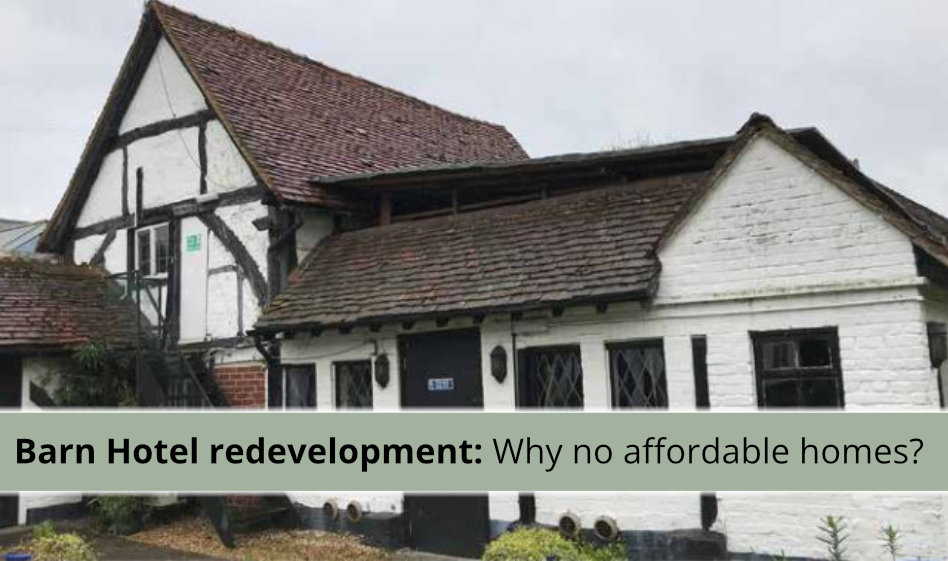
Many residents have understandably asked why the redevelopment of The Barn Hotel on West End Road will consist entirely of private housing, with no affordable homes included. Given that local planning policy normally seeks around 35% affordable housing on schemes of this size, the absence of any such provision has caused concern.
The short answer is this: after detailed financial scrutiny, the scheme has not been shown to generate enough surplus to fund affordable housing without becoming loss-making. The longer answer involves a technical dispute about land value, construction costs and what is known in planning terms as “viability”.
The Rules of the Game: Viability
When a developer claims that affordable housing would make a project unviable, they must submit a Viability Assessment. This is a detailed financial appraisal that sets out:
- The expected sales value of the completed homes
- The cost of building them
- A “reasonable” developer profit
- The value of the land in its current use
If, after allowing for costs and a reasonable profit, there is no surplus remaining, affordable housing can be reduced or removed.
The Barn Hotel scheme has been assessed under this process.
The Key Issue: How Much Is the Site Worth?
At the centre of the debate is something called the Benchmark Land Value (BLV). In simple terms, this is the baseline value of the site in its existing use — in this case, as a hotel.
Savills, acting for the developer, rely on a previously agreed benchmark of £3.52 million. That figure was based on a 2023 valuation of the hotel as a trading business, before it closed later that year.
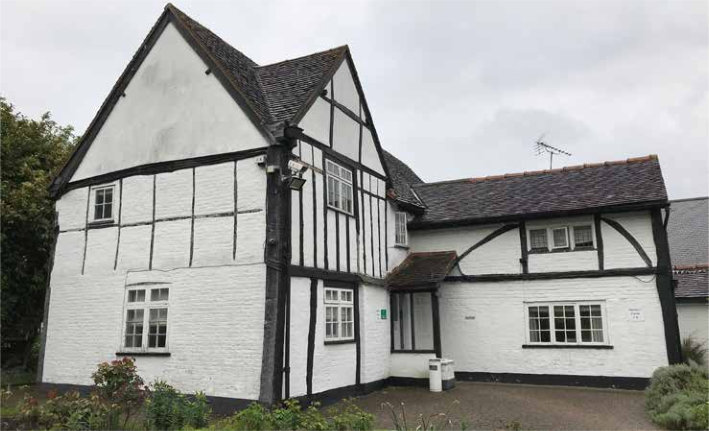
However, the hotel ceased trading in October 2023 on viability grounds. Earlier reports prepared by Savills themselves concluded that the hotel was commercially unviable in the long term. Structural surveys also identified signs of deterioration and the need for repairs.
Hillingdon Council therefore commissioned independent advisers (Quintic Advisory) to review the figures. They questioned whether a closed and deteriorating hotel could realistically still be worth £3.5 million as an operating business. To test the position, they modelled a much lower notional benchmark of £500,000 — about the same as a single home in Ruislip.
The Developer’s Case
Using the £3.52 million benchmark and construction costs of around £25 million (reflecting the expense of restoring listed buildings and dealing with infrastructure works), the developer’s appraisal shows only a 3% profit margin on the scheme.
Developers typically require returns of around 15–20% to reflect risk. On that basis, they argue that the scheme is already financially marginal and cannot support affordable housing without becoming unviable.
The Council’s Challenge
The Council did not accept those figures without scrutiny. Independent consultants:
- Reduced construction costs slightly
- Reduced contingency allowances
- Adjusted sales values
- Lowered the assumed land value dramatically
Even with those tougher assumptions — and even assuming grant funding for affordable housing — the numbers still did not support a policy-compliant level of affordable housing. When a 20% affordable housing scenario was tested, the scheme moved into a deficit of over £1 million.
In other words:
- Using the developer’s assumptions → no affordable housing is viable.
- Using the Council’s stricter assumptions → still no affordable housing is viable.
The underlying problem is that the redevelopment — particularly the restoration of Grade II listed buildings and the required infrastructure works — is extremely expensive relative to the achievable sales values in this part of Ruislip.
The Uncomfortable Reality
Viability assessments are controversial because they rely on projections and assumptions. However, in this case, the Council has independently reviewed and challenged the figures. The adjustments made in the Council’s favour improved the financial position only slightly.
Even when the site is treated as being worth little more than a standard single house, there is not enough financial headroom in the scheme to fund affordable housing and still leave the project commercially workable.
Conclusion
This does not mean the Council has “given in” to the developer. The figures have been examined and tested. However, based on the current evidence, the redevelopment does not generate sufficient surplus to support affordable housing.
The absence of affordable homes on this site is therefore not the result of a lack of policy ambition, but the financial reality of restoring historic buildings and redeveloping a complex brownfield site.
Residents may reasonably be disappointed. But unless there is a significant shift in land value, construction costs or achievable sale prices, affordable housing on the Barn Hotel redevelopment is unlikely to be delivered.

Comments are closed.