
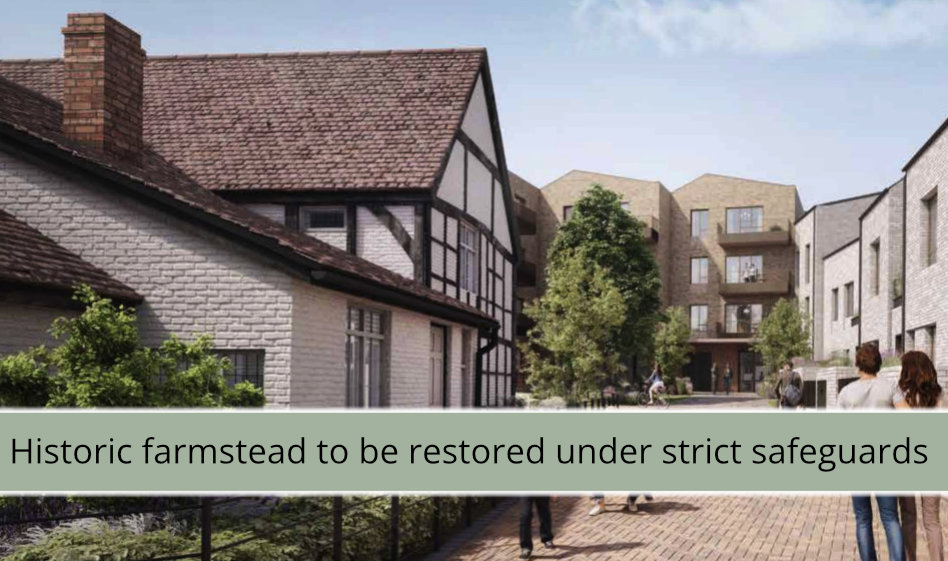
Because many residents have asked if , or think the listed buildings are being demolished (they are not), it is worth briefly summarising the views of the two statutory heritage consultees: Historic England and the Greater London Archaeological Advisory Service (GLAAS).
Historic England: “A Considerable Improvement” and a Heritage‑Led Scheme
Historic England has reviewed the revised proposals and is broadly supportive. They emphasise that the historic farmstead at the centre of the site is an important remnant of medieval Ruislip, with the farmhouse and barn likely dating from the early 16th–17th century. Their assessment notes that:
- Removing the later, unsympathetic hotel extensions will have a clear positive heritage effect.
- Converting the listed buildings sensitively is welcomed.
- Although the setting will become more urban, the revised layout and roofscape represent a “considerable improvement” over the original submission.
- The scheme could satisfy the National Planning Policy Framework’s heritage and design policies, provided high‑quality materials and detailing are secured.
Historic England’s formal recommendation is that the Council should approve the application unless other planning considerations indicate refusal, as any heritage harm is limited and outweighed by the benefits of restoring and reintegrating the listed buildings.
GLAAS: Archaeology, Historic Recording and Public Engagement Required
GLAAS focuses on archaeology and the historic fabric of the listed buildings. Their advice confirms that the site has genuine archaeological interest, because Sherley’s Farm formed part of the historic Field End hamlet and contains three listed farm buildings, two with probable 16th‑century origins. They highlight:
- Potential for buried archaeological remains in areas outside the post‑war hotel buildings.
- Potential for new discoveries within the listed buildings themselves, including dendrochronology (tree‑ring dating) of timber frames.
- Risk of harm from new foundations, landscaping, ponds and access roads.
GLAAS therefore recommends several mandatory planning conditions, including:
- A two‑stage Written Scheme of Investigation (WSI):
- Stage 1: Trial trenching to establish what survives.
- Stage 2: Full excavation if significant remains are found.
- A Historic Building Recording condition before any demolition.
- A watching brief during conversion works.
- A programme of public engagement, such as open days, viewing platforms, school involvement, interpretation panels and community heritage activities.
GLAAS is clear that without these pre‑commencement conditions, the application should be refused under NPPF paragraph 211.
Why This Matters for Residents
These statutory responses make two things absolutely clear:
- The listed buildings are not being demolished. Only the later hotel additions are being removed; the historic farmhouse and barn will be retained and restored.
- The heritage bodies are broadly supportive, provided strict archaeological and historic‑recording safeguards are imposed.
This context is important because many objections have been based on the misconception that the Grade II buildings are to be lost. In reality, both Historic England and GLAAS view the revised scheme as an opportunity to secure the long‑term future of the historic farmstead, while requiring robust investigation and public engagement. ALL this comes at a cost!!!

Comments are closed.