
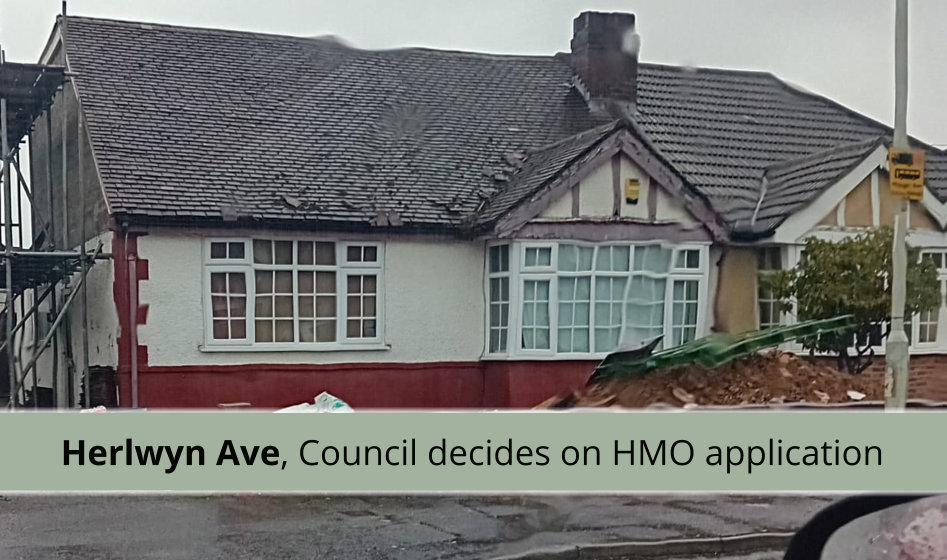
The Ruislip Residents’ Association (RRA) can now confirm the official reasons for the refusal of planning application 149 Herlwyn Avenue (Ref: 19188/APP/2025/3239). The decision, issued on 20th March 2026, follows an extensive period of community consultation and technical review by Hillingdon Council.
While the physical extensions to the property were generally considered acceptable in terms of size and scale, the application was refused based on the following three key planning grounds:
Official Reasons for Refusal
Impact on Neighbour Amenity and Character:
- The council determined that the number of occupants and the nature of the HMO use represented an over-intensification of the site. This would result in unacceptable noise and disturbance for adjacent residents, exceeding what is expected for a single-family dwelling and clashing with the established residential character of the area.
Unsatisfactory Internal Living Environment:
- The proposed layout was found to be sub-standard. Specifically, the council noted a failure to provide adequate communal space and facilities for the intended six occupiers.
Parking and Highway Safety:
- The applicant failed to provide evidence – such as a parking stress survey – demonstrating that the local streets could accommodate the additional parking demand. Given the area’s low public transport accessibility (PTAL 2), the council concluded the proposal would likely lead to harmful on-street parking displacement and safety issues.
Procedural Background
The application was formally amended during the process to be “part-retrospective,” acknowledging that building works had already commenced on-site. The RRA Planning Representative, Sue Browne, worked closely with council officers to ensure the application description accurately reflected these ongoing works.
The RRA also notes the significant community engagement during the consultation period:
- 169 letters of representation were received, all objecting to the proposal.
- A formal e-Petition of 1,120 valid signatures was submitted against the development.
- Local ward Councillors Douglas Mills and Susan O’Brien formally opposed the change of use, citing the material change it would bring to the character of the road.
Next Steps and Enforcement
The refusal of planning permission is a significant stage in the process. While the applicant has the right to appeal this decision to the Secretary of State within six months, the council retains the right to pursue enforcement action regarding any unlawful development that has already taken place. Residents are reminded that a property must meet both Planning and Licensing requirements to operate legally as an HMO. The RRA will continue to monitor the status of this site and provide updates as they become available.
Read officers' reasons for refusal
Impact on Neighbour Amenity and Character
The proposed development, by virtue of the number of potential occupants and proposed use, would represent an over-intensification of the site which would be harmful to the amenities of the neighbouring properties and at odds with the established character of the surrounding locality. The proposal would have an unacceptable and undue impact on existing residential amenity in terms of noise and disturbance, over and above what would be expected for a single family dwelling. As such, the proposal would therefore be contrary to Policy EM8 of the Hillingdon Local Plan – Part 1: Strategic Policies (2012), Policies DMH 5 and DMHB 11 of the Hillingdon Local Plan: Part 2 – Development Management Policies (2020) and Policy D14 of the London Plan (2021).
Unsatisfactory Internal Living Environment
The proposed development, by virtue of its layout, internal design and number of potential occupants, would fail to provide adequate communal space and facilities for the future occupiers. As such, the proposed development would provide a sub-standard and unsatisfactory level of internal living accommodation, contrary to Policy DMH 5 of the Hillingdon Local Plan: Part Two – Development Management Policies (2020) and Policies D3 and D6 of the London Plan (2021).
Parking/Highways
In the absence of any submitted details or evidence with regard to the level of present on-street parking demand within the locality and whether any spare capacity exists which could satisfactorily accommodate the potential parking displacement generated by the proposed level of occupancy, it is considered that the proposal has the potential to lead to undue on-street parking displacement to the detriment of parking capacity and safety on the local public highway. As such, the proposal would be contrary to Policies DMT 1, DMT 2 and DMT 6 of the Hillingdon Local Plan: Part Two – Development Management Policies (2020) and Policy T4 of the London Plan (2021).
Councillors’ submission
Councillor Douglas Mills contributed to the planning consultation with the submission:
“On behalf of nearby Herlwyn Ave residents we oppose this application to change from the existing C3 dwellinghouse criteria to a small HMO. Herlwyn Ave properties have always been and should continue to be about single persons/small family homes. Their proximity to schools and Ruislip High St means it is ideal for this type of occupation. Even with the promise of a management plan, the reality is that occupation by 6 individuals will bring a material change to the character of this road, a greater level of alteration to the front of the property compared with the surrounding neighbours and increased parking on what is a residential road, leading to a primary school. Such a change to the overall street character is not in keeping with the location.”
Why “Loss of a Family Home” Was Not a Reason for Refusal
Many residents, along with Councillor Douglas Mills, strongly objected to the application on the basis that it would result in the loss of a much-needed family home. However, the Planning Officer noted in the report that this cannot legally be used as a reason for refusal.
Under Hillingdon’s Local Plan (specifically Policies DMH 1 and DMH 4), “residential accommodation” is safeguarded. Because the property is being converted from one type of residential use to another (an HMO is still classed as residential floorspace), the council does not consider the housing to be “lost.” Furthermore, the officer highlighted a recent planning appeal in the borough where a government Inspector ruled that the loss of a family home to an HMO “did not conflict with local policy and was not sufficient grounds for refusal in and of itself.”
Therefore, while the council could not refuse the application just for being an HMO, they were able to refuse it based on the tangible, negative impacts that six occupants would have on the property and the surrounding street.
Community feedback
The Facebook discussion within the Ruislip community reflected a mix of relief regarding the Herlwyn Avenue refusal and growing frustration over other suspected HMO conversions in the area. Residents specifically flagged properties at 29 Torrington Road and 11 Woodville Gardens, noting that internal works – such as stripping houses to create six-unit layouts – often appear to be completed before planning applications are even submitted. Many expressed concern that these developments lead to a deterioration of the neighborhood, citing specific issues with increased fly-tipping and unmanaged refuse attracting pests as symptoms of over-intensified occupancy.
It is important to remain proactive
A significant portion of the conversation focused on the perceived lack of proactive oversight from the Council. Residents described feeling as though their reports went into a “black hole” with little to no feedback on enforcement cases. In response, RRA Planning Representative Susan Browne and Councillor Susan O’Brien urged the community to remain proactive, emphasizing that Planning Enforcement relies on public reports to trigger investigations. There was a strong consensus that without such vigilance, developers might continue to bypass the legal process, assuming that a housing shortage will serve as an excuse for retrospective approval.
Planning History for 149 Herlwyn Avenue
According to the official Officer’s Report, the property has the following recent planning history:
- September 2024 (Ref: 19188/APP/2024/1794): The Council granted approval for the erection of a single-story rear extension. While this specific permission was never implemented, it remains “extant” (legally active), meaning a standard residential extension of 3.6m in depth could still potentially be built under this previous consent.
- June 2024 (Ref: 19188/APP/2024/1672): A “Prior Approval” application was submitted for a larger 6-meter single-story rear extension. The Council ruled that “No Further Action” was required for this specific submission.
- December 2025 (Ref: 19188/APP/2025/3239): The current application was submitted for the HMO conversion and associated structural works. During the process, the description was updated to a “Part retrospective application” after it was confirmed that works had already commenced on-site without prior consent.
The Planning Officer noted that while the physical extensions proposed in the latest application (the 3m rear extension and loft conversion) were largely consistent with local design standards, they could not be separated from the “over-intensification” of the HMO use itself, leading to the overall refusal.

Comments are closed.