
Our Community became more water aware after the flooding of June 23rd 2016. We have seen Natural Flood Management installed in Park Wood SSSI as part of the DEFRA funded Pilot Study (2018-21), and some 80 Ruislip residential properties benefitting from the property level protection, both adjacent to the River Pinn, (Frequently Flooded Communities fund), and along the Cannon Brook through a scheme managed by our Council as Lead Local Flood Authority.
On a day-to-day basis it is easy to forget that Ruislip was founded along the River Pinn as a reliable source of drinking water. What is the quality of the water in the Pinn today? Does our river support all the life it could? Members of the Ruislip Residents’ Association Watercourses sub-committee have contributed to the current Zoological Society of London River Pinn Outfall Safari, mapping and assessing the accessible outfalls into the Cannon Brook, while other Groups, to include the Friends of Pinn Meadows have done the same for the Pinn. This will guide investigations to track down and resolve mis-connections that lead to foul water being diverted into our River.
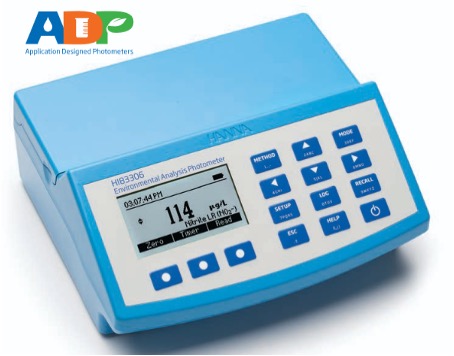
Alongside this RWMAG, (Ruislip Woods National Nature Reserve Management Advisory Group), working with the Ruislip Woods Trust, (RWT), have made a successful funding application to the Empower Rivers Community Grant, to fund a suitable Hanna meter and sufficient reagent to check 300 River Pinn and tributaries water samples for ammonia, nitrate, phosphate, Iron, Copper, Zinc, dissolved Oxygen, pH, total conductivity and sample temperature.
HI83306 Multiparameter Photometer
with Digital pH Electrode Input for Environmental Analysis
The HI83306 benchtop photometer measures 16 different key water quality parameters using 23 different methods. This photometer features an innovative optical system that uses an LED, a narrow band interference filter, a focusing lens, and both a silicon photodetector for absorbance measurement and a reference detector to maintain a consistent light source to ensure accurate and repeatable photometric readings every time.
The HI83306 was developed to measure the most common parameters in environmental water quality monitoring. Nutrients such as nitrates and phosphates are key indicators of nutrient pollution from agricultural sources and are considered dangerous to environmental waters. Too few nutrients and waters will be unable to sustain healthy ecosystems; too many nutrients and algal blooms can form, which can be detrimental to water quality and aquatic health. Dissolved oxygen is an essential to performing biological processes for many forms of aquatic life, such as fish, plants and microorganisms.
Absorbance mode
-
Hanna’s exclusive CAL Check™ cuvettes for validation of light source and detector
-
Allows for the user to plot concentration versus absorbance for a specific wavelength for use with user supplied chemistry or for teaching principles of photometry
Data Logging
-
Up to 1000 photometric and pH readings can be stored by simply pressing the dedicated LOG button. Logged readings are just as easily recalled by pressing the RCL button.
-
Sample ID and User ID information can be added to a logged reading using the alphanumeric keypad
- Ammonia is an indicator of foul water, most likely via mis-connection reaching our river
- Nitrate, in excess, can lead to eutrophication and blue-green algal blooms
- Phosphate is essential for plant growth. Is phosphate leaching out of Ruislip Woods NNR
- Ferrous Iron is known to leach out of the Lambeth Clay soils under Park Wood SSSI. Initial work with Thames Water in 2023 showed appreciable levels of ferrous iron. How does the Iron content of Pinn water vary between seasons?
- Copper, or rather organic Copper compounds are formed in the environment when brake and clutch pad dust are flushed from toads into our watercourses. How much organic Copper is in the River Pinn?
- Zinc Oxide is used in every vehicle tyre. Organic Zinc compounds from when tyre debris is flushed from our roads into our rivers. What levels of organic Zinc are in the river Pinn?
- Dissolved oxygen: a river with low levels of dissolved Oxygen cannot support the web of life associated with a river.
We hope to start amassing data on the above parameters from May 2026. The data will be shared with statutory bodies, to include Thames Water, Affinity Water, the Environment Agency, through ColneCAN, (Colne Catchment Action Network), and others to include the Zoological Society of London, Groundwork South, the EA Colne Catchment Manager.
We also have academic oversight from members of the River Science team at Brunel University – London, and hope to work with Brunel students enrolled on the Environmental Science M.Sc. course.
An online briefing session will be held in May for any interested residents.
Reference Information
Link to 2025 Glossary newly revised
London Climate Resilience Review
London Surface Water Strategy Group Interim Report
EA River Pinn Level gauge at St. Martins Approach
EA Cannon Brook level gauge at Howlett’s Lane
DEFRA Rainfall and river flow tables for English regions
Met Office Climate summary for Southern England
Climate Change Risks for London Report to GLA
GLA Rewilding Final Report of the London Rewilding Taskforce
River Colne Catchment Action Network: ColneCAN


Comments are closed.