
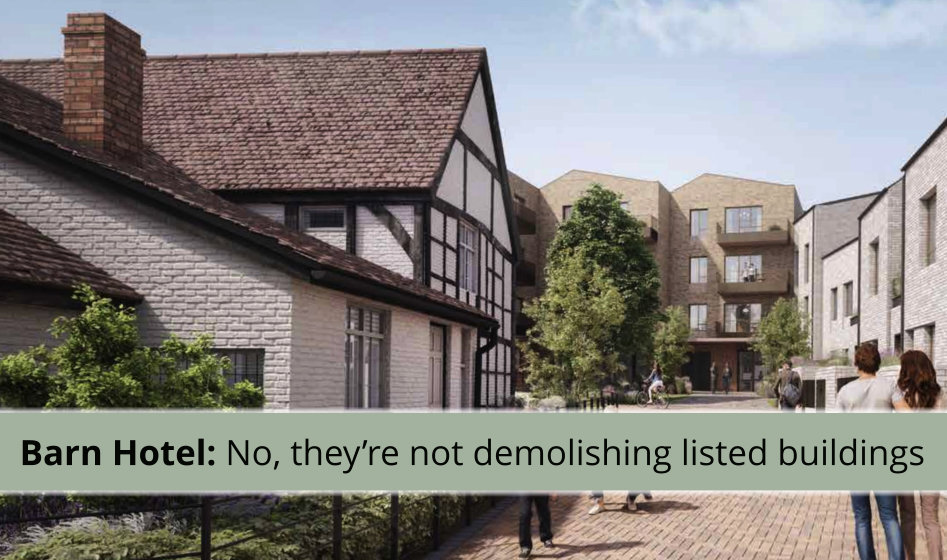
 Many residents have understandably been concerned by the wording of the latest planning application for the former Barn Hotel site on West End Road, particularly the phrase: “partial demolition of 1no. Grade II Listed Building.” Read on its own, that sounds alarming.
However, a review of the revised planning application indicates the proposal does not involve demolishing the main historic listed buildings in their entirety. This article explains, in plain English, what the current scheme actually proposes.
The scheme in simple terms
The application proposes to completely redevelop the former Barn Hotel site into a residential neighbourhood of 71 homes.
- 68 homes would be located in newly constructed buildings ranging from two to four storeys across the wider site.
- 3 homes would be created by converting the retained listed buildings.
The site would include new landscaping, access arrangements, and parking (including disabled bays and cycle stores). The latest documents describe the housing mix as 26 one-bedroom, 30 two-bedroom, 14 three-bedroom, and one four-bedroom homes.
What are the listed buildings?
The site contains two main Grade II listed heritage assets:
- Sherley’s Farmhouse: A historic farmhouse.
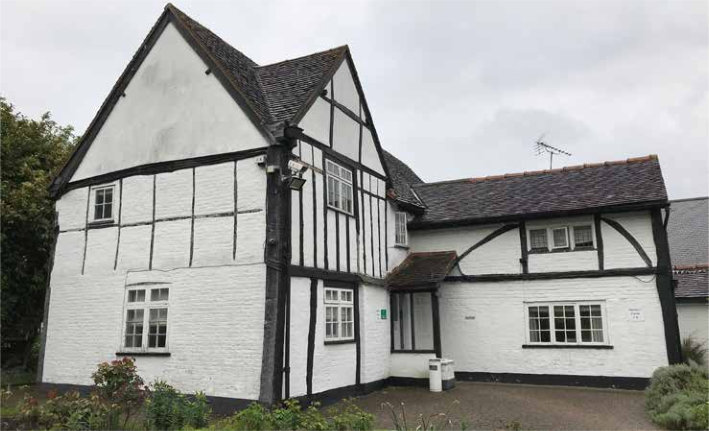
Sherley’s Farmhouse, one of the Grade II listed buildings on the site.
- The Barn and outbuildings: The structural report describes the Leaning Barn as a late 16th or early 17th-century timber-framed structure, with the Oak Room to the north and Sherley’s Farmhouse further north again.
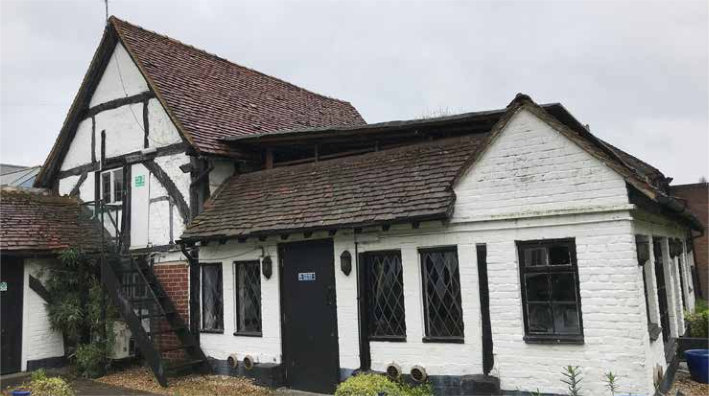
Barn and outbuildings to south east of Sherley’s Farmhouse (Grade II)
The Heritage Assessment identifies that these buildings sit within the site, while Ruislip Station and the Ruislip Village Conservation Area are nearby heritage assets.
Are the listed buildings going to be knocked down?
No. The main historic listed buildings are not proposed to be demolished in their entirety.
Instead, the scheme proposes that:
- Sherley’s Farmhouse would be converted into one four-bedroom house.
- The Leaning Barn and Oak Room would be converted into two houses.
The historic buildings would be repaired and brought back into active residential use. The applicant’s heritage case argues that converting them into homes would give the buildings a long-term use, help fund necessary repairs, and reduce the risk of further deterioration now that the hotel has closed.
So why does the application say “partial demolition”?
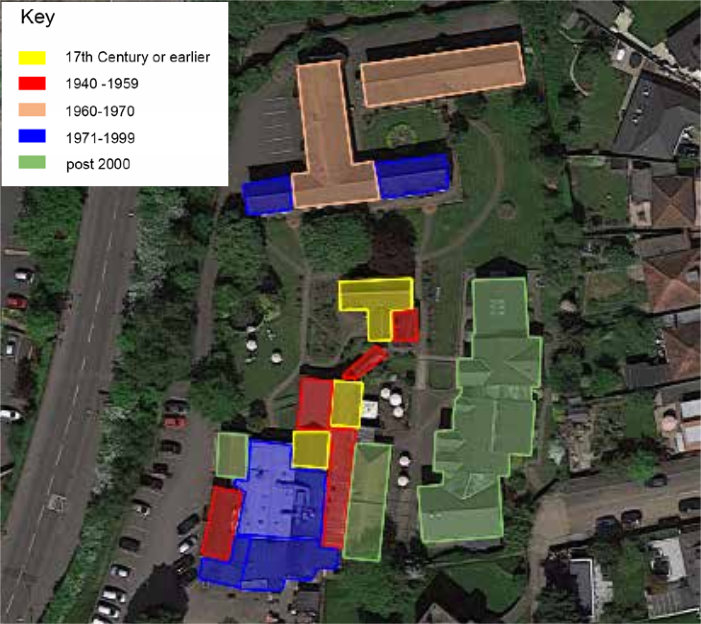
In planning terms, this phrase appears to refer mainly to the removal of the modern, poor-quality hotel extensions and structures that were tacked onto the historic barns during the 20th century.
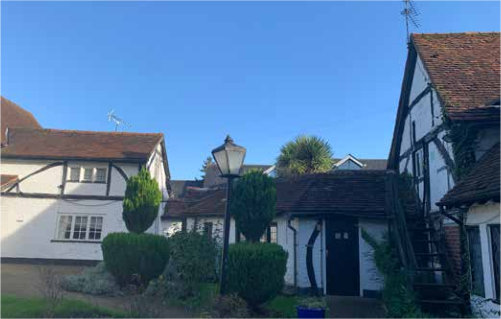
The modern hotel extensions (centre) that currently block the historic spatial relationship between Sherley’s Farmhouse (left) and the barn buildings (right). These are the structures proposed for demolition.
The intent is to demolish these “detracting” modern additions to expose the original historic timber frames and reinstate the visual relationship between the barns and Sherley’s Farmhouse.
The structural report states that the redevelopment involves demolishing the modern buildings surrounding the Leaning Barn, while adding a new single-storey extension to the north so it can function as a modern home. In short: the proposal is not to flatten the listed buildings, but to peel away the modern hotel additions around them.
What else would be demolished?
The bulk of the modern, 20th-century hotel buildings across the wider site would be completely cleared to make way for the new housing blocks.
What would be built in their place?
The new development would include a mixture of houses and flats in several blocks. The layout has been revised to improve pedestrian routes and define public and private spaces more clearly:
-
-
- Block A: Two 2-storey semi-detached houses.
- Block B: A 4-storey building with 8 flats.
- Block C: A 3-storey building with 15 flats.
- Blocks D and E: Two pairs of 2-storey semi-detached houses.
- Block H: A 2-storey terrace of 8 houses.
- Block K: A 4-storey building with 31 flats.
- Block F: The listed Leaning Barn / Oak Room (converted into 2 houses).
- Block G: The listed Farmhouse (converted into 1 house).
-
What is the applicant saying about heritage?
The applicant argues that the current hotel layout left the historic buildings somewhat hidden, altered, and surrounded by later development and hardstanding.
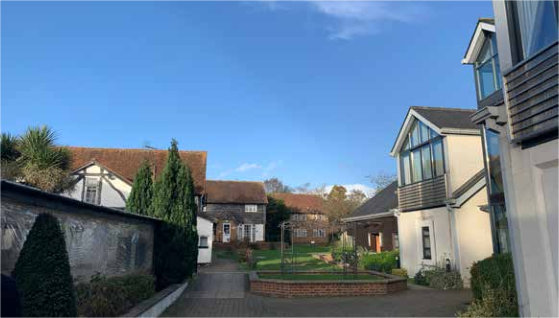
The historic green setting of the farmhouse has been lost over the years due to hotel development and hard landscaping.
The Heritage Assessment says the setting of Sherley’s Farmhouse has been harmed by this over the years. By removing these later additions, repairing the buildings, and giving them a proper landscaped setting, the developer argues the historic farmstead would be easier to appreciate.
Does this mean residents should not be concerned?
Absolutely not. While the historic buildings are not proposed to be flattened, the wider scheme remains highly controversial. Residents must still look critically at:
- The substantial scale and height of the new buildings, especially the 3- and 4-storey blocks.
- The impact on neighbours in Garden Close, Eversley Crescent, and nearby roads (including overlooking, daylight, and privacy).
- Traffic and access, particularly the proposed main access point shifting to Garden Close.
- Parking levels and potential construction impacts.
- The detailed quality of the proposed repairs to the listed buildings.
- Whether the new, modern buildings genuinely enhance the setting of the heritage assets.
Whether heritage and archaeology consultees should be reconsulted: Given the significant changes to the layout and groundworks in the new 2026 scheme, the RRA believes the Council must formally reconsult Historic England and GLAAS regarding buried archaeology before proceeding. (See our full urgent update on this issue).
In Summary
The Barn Hotel site would change permanently, replaced by a substantial residential development of 71 homes.
While fears that the historic listed buildings are going to be flattened are not supported by the submitted documents, the main areas of concern lie in the scale, access, parking, neighbour impacts and heritage setting of the new development. Residents should scrutinise the application carefully and make their voices heard.
So what next?
The consultation on the new version of the application starts today (11th May 2026) and Ruislip Residents’ Association is working through the details now. We will be back with more details once we have read through things ourselves.
If you join our newsletter mailing list, we’ll be able to let you know more when we have something to actually say – it’ll be a couple of days.

Comments are closed.