On 6th May, the Ruislip Residents’ Association published an article using Freedom of Information (FOI) data to assess the impact of Hillingdon Council’s new garden waste charge.
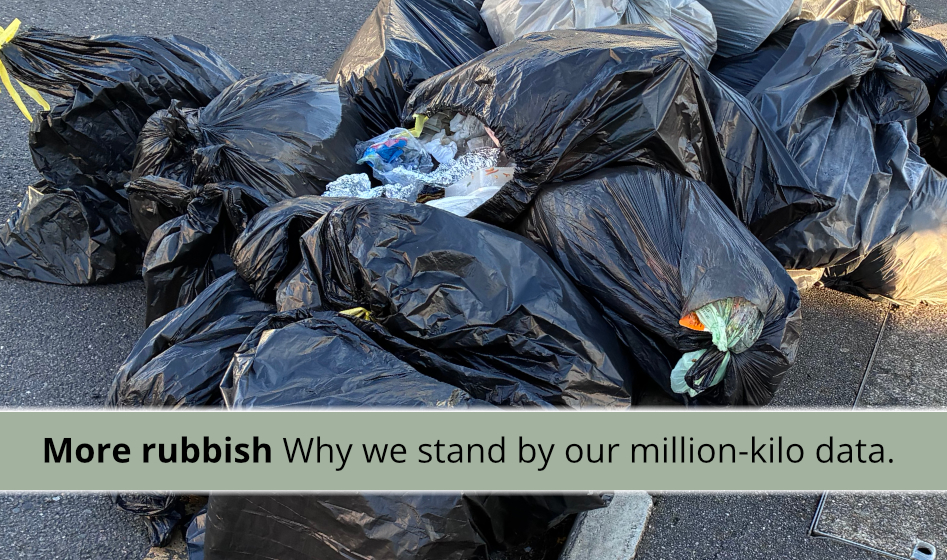
The data showed a significant drop in kerbside green waste collections, alongside an increase in general “black bag” residual waste of approximately 1245 tonnes (or 1.2 million kilos) compared to the pre-charge average. It also highlighted a shortfall against the scheme’s original £2.5 million financial target.
On 20th May, the Council’s Corporate Communications team contacted us to provide updated subscriber numbers, suggest unit formatting changes, and raise objections to some of our conclusions.
We welcome the Council’s engagement. We have added an update to our original article to reflect the latest subscriber count (increasing mid-April’s 14,985 subscribers by 3515 to 18,500 – which is still 4740 short of last year’s paying subscriber numbers) and adjusted the formatting of our unit measurements as requested. However, having reviewed the Council’s comments, we do not believe it is necessary to change our calculations or core conclusions.
Here is a summary of the Council’s feedback and why we stand by our analysis:
-
The increase in black bag waste
The Council felt our article misleadingly suggested the rise in black-bag waste was due to residents putting garden waste in them. They noted that other factors – such as the weather, and new flats without gardens increasing general waste – play a part.
- Our Response: We acknowledge these factors, but the correlation remains highly relevant. In the Council’s own pre-launch consultation, 26% of respondents (over 2100 residents) explicitly warned they would put garden waste in their general bins if a charge was introduced. When we asked via FOI how many warning stickers have been issued to monitor this, the Council confirmed they do not hold that specific data. Given the consultation warnings and the lack of specific enforcement data, highlighting the simultaneous drop in green waste and rise in residual waste is reasonable and in the public interest.
-
Assessing the financial targets
When the Council introduced the charge in May 2025, the Cabinet report explicitly stated its aim was to deliver a £2.5 million saving. The Council has now asked us to note that they are “on track to reach the 2026/27 target of £1.8 million (not the £2.5 million figure stated).”
- Our Response: We are aware the Council is now aiming for £1.8 million. This appears consistent with the Council’s 2026/27 budget papers, which include a £610,000 “Rebasing of garden waste income” line. In this context, rebasing appears to be an accounting adjustment reflecting a lower expected income position than the original £2.5 million saving. While the Council has revised its internal targets downwards for Year 2, our role is to assess the scheme against the original £2.5 million savings promise made to taxpayers when the policy was approved.
-
The “Disposal Penalty”
Our article calculated that the 1245-tonne (1.2 million kilo) spike in black-bag waste represents an estimated £132,000 “disposal penalty.” This is because disposing of green waste costs £40.18 per tonne, whereas incinerating general black-bag waste costs £146.22 per tonne. The Council stated they “do not recognise any form of disposal penalty.”
- Our Response: While the Council may not apply this penalty as a line item in their internal service budgets, the cost differential is a reality. To the extent that waste moves from the cheaper green-waste stream into the more expensive residual-waste stream, it creates an additional cost that is ultimately borne through the Council’s waste budget. This is a cost, even if not direct, to the taxpayer.
Our Commitment to Residents
Our duty as an independent Residents’ Association is to provide transparent, easily understandable analysis of local data so residents can see exactly how policies impact the borough.
We thank the Council for providing the updated figure of 18,500 subscribers, and we have gladly published this new data. However, we remain confident in our methodology and we will continue to report what the available data shows, while publishing relevant updates and responses.
- You can read our original data analysis, including the Council’s updated subscriber figures, in our article “Over million kilos of extra rubbish went in black bags after Hillingdon’s Garden Waste subscription started“
Read the correspondence in full
Read email from Hillingdon Corporate Communication
The following article has come to the council’s attention and we would be grateful if feedback can be addressed by way of revisions: Over million kilos of extra rubbish went in black bags after Hillingdon’s Garden Waste subscription started | Ruislip Residents’ Association
We feel that despite a one-line disclaimer lower down in the article, the narrative misleadingly suggests that an increase in black bag waste is because residents are putting garden waste in them.
For example: “To put that into perspective, it is roughly equivalent to 83,000 standard 15kg bags of compost.” This does not align with what the council’s collection crews are seeing. Black bag waste levels were higher in 2023-24, prior to the introduction of the garden waste fee.
We also feel there’s flawed use of the figures and that the representation of change in tonnage as being down to garden waste is incorrect.
Presenting figures using differing measurements can be misleading. For example: “At first glance, 1.2 million kilograms sounds almost unbelievable. But Hillingdon collected 32,831 tonnes of residual waste in the same period”. This could be written as: “At first glance, 1.2 million kilograms sounds almost unbelievable. But Hillingdon collected 32.8 million kilograms of residual waste in the same period”
The article compares behaviours for three years prior to a key service change. To give a fairer perspective, it would be reasonable to allow equal time after the launch to judge any behaviour changes.
It is also unrealistic to expect all previous subscribers to resubscribe immediately. The council has taken a phased approach to resubscription, and at present, there are 18,500 subscribers (approximately 82% of last year’s total), after two email reminders with the council still on track to reach the 2026/27 target of £1.8 million (not the £2.5 million figure stated).
An increase in garden waste disposal at Harefield Civic Amenity site was anticipated and expected as part of the modelling alongside an increase in people home composting.
Additionally, the net contribution of £885k in the final table looks incorrect and we welcome further explanation of the calculation. As set out above, the council is on track to retain at least its current level of subscribers which would generate an income of £1.8 million and have budgeted implementation costs of £137k. This gives a net contribution to the costs of collection of £1.66 million. Noting the council does not agree that there is a disposal penalty, even if this were applied as a cost, the council would still have a net contribution of £1.52 million to the costs of providing this service. The council believes this sufficiently answers the question “is the garden waste charge really saving Hillingdon money?”.
Under the previous garden waste service, all residents paid to subsidise the service whether they used it or not and regardless of whether they had a garden. Under the new fee-based service only those who use the service will be charged a subscription which is fairer for the rest of the borough.
There was no previous income from the scheme. Any money made from the fee-based service contributes to the costs of collection incurred by the council.
Additionally, garden waste tonnages can vary hugely with weather. The summer of 2025 was extremely dry meaning very low levels of vegetation growth and reduced tonnages.
A charged for scheme can also encourage home composting, which is a good thing. The assumption that all green waste is diverted into general waste is not evidenced.
It’s also worth noting that it’s likely that most new build homes in the borough are predominantly flats, where there is no need for garden waste service, but there is need for general waste, so this could also skew the figures.
As a result of property growth, variable weather-related tonnages, short periods of assessment and other diversion routes, the council does not recognise any form of disposal penalty.
It may also be useful to include a link in the piece for any residents wishing to sign up.
Yours sincerely,
Hillingdon Council Corporate Communications team
Read our reply
Dear Hillingdon Corporate Communications Team,
Thank you for your feedback regarding our recent article on the garden waste subscription service. We always welcome engagement from the council.
However, having reviewed your points against the data provided in the FOI response and the council’s own published reports, the Ruislip Residents’ Association stands by the substance, calculations, and conclusions of our article.
Regarding the assertion that it is “misleading” to link the 1,245-tonne increase in black-bag waste to the garden waste charge: the council’s own pre-launch consultation showed that 26% of respondents (over 2,100 residents) explicitly warned they would put garden waste in their general refuse if a charge was introduced. Furthermore, the FOI confirmed the council holds no specific data on how many enforcement stickers have been issued to police this. In the absence of specific monitoring data, drawing attention to the correlation between a substantial drop in kerbside green waste and a simultaneous rise in residual waste is not misleading; it is a reasonable interpretation of the available data.
Regarding the financial targets: we will not be revising the £2.5 million figure down to £1.8 million. The May 2025 Cabinet Member Report explicitly justified the introduction of this charge to the public by stating it would deliver a £2.5 million MTFS saving. The fact that the council has now internally revised its target downwards because of low uptake does not change the original promise made to taxpayers.
Regarding the “disposal penalty”: while the council may choose not to “recognise” it, the mathematical reality outlined in the May 2025 report is that residual waste costs £146.22 per tonne to dispose of, compared to £40.18 for green waste. Taxpayers are bearing the cost of that differential for the extra 1,245 tonnes of general refuse.
We have updated the article to reflect the current 18,500 subscriber count as requested. We have also standardised the weight measurements in the section you highlighted to kilograms, as you suggested, to ensure absolute clarity. However, we will not be altering the financial calculations or our conclusions.
Our duty is to provide transparent, easily understandable analysis to the residents of Ruislip Manor and Ruislip, and we believe this article does exactly that.
Yours sincerely,
Ruislip Residents’ Association
To subscribe to Hillingdon’s Garden Waste service
The Council also asked us to provide a link to the subscription form for residents wishing to pay the £77 and join the garden waste collection service. We of course already covered the subscription launch and promoted it across our social media accounts and email newsletters when the service launched.
In fact, the Cabinet Member intervened to update the terms and conditions of the scheme after we pointed out problems with it.
We posted again when the new plastic tags were dispatched, giving details on how residents could subscribe.
Our original, unedited, article is archived here and the amended copy is live in place on our website for everyone to read.
- Residents wishing to subscribe to the garden waste service can call 01895 556000 or visit Hillingdon Council’s website here.
We look forward to further engagement with the Council, and our five ward councillors, in the future. Separately, we are awaiting responses to three outstanding FOI requests and will update residents when replies are received.

Comments are closed.