
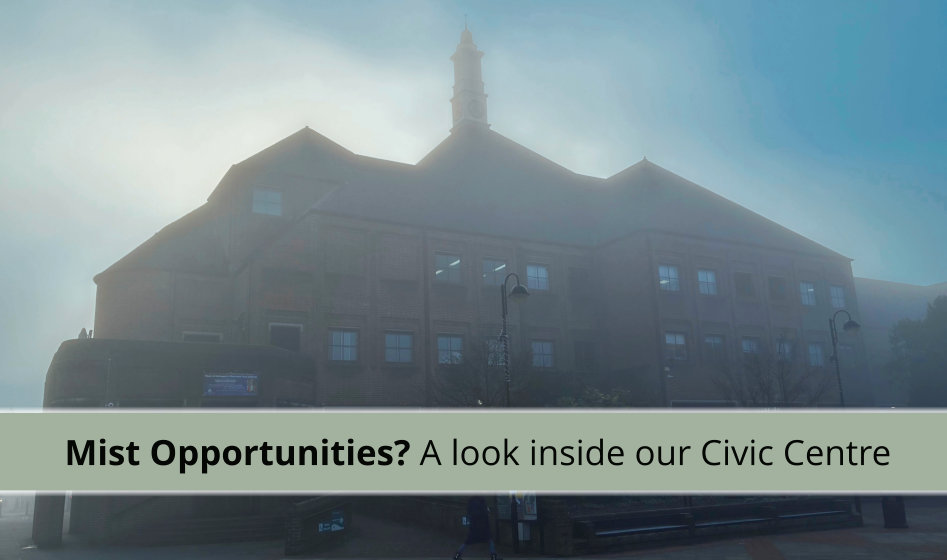
Hillingdon Council is asking for a £150 million government bailout but it isn’t free money. It represents more than a £1400 debt for every single household in the borough, a burden we will be paying back with interest for the next 20 years—money that will service debt rather than fund local services. While the Council blames external factors like Heathrow, their own records tell a different story: one of systemic failure, disclaimed accounts, late-filed reports, and ‘unreliable’ figures.
The admission this week that the Breakspear Road closure notice “made no sense” is just the latest in a worrying series of administrative failures, secrecy, and financial mismanagement at the Civic Centre.
Whenever our Borough’s finances are discussed, residents are given the same explanation: Heathrow, asylum seekers, Chagossian arrivals – national pressures beyond the council’s control. It is a convenient story, repeated in most answers to questions at public meetings, and by the Leader of the Council in monthly emails and the Hillingdon People magazine.
It is not the one told by the Council’s own budget, or their external auditors. Buried in the late-published 2026/27 budget papers are a series of admissions that point elsewhere: long-standing accounting errors, savings plans that repeatedly failed to deliver, and years of budgets built on incomplete data and unrealistic assumptions.
“The Council faces systemic weaknesses in its financial governance arrangements, including weaknesses in budget setting, budget monitoring and financial reporting, resulting in unreliable forecasts.”
Read carefully, the budget does not describe a council overwhelmed by external shocks – it describes a council struggling with the consequences of its own decisions.
While mistakes happen, the frequency and nature of these errors suggest a systemic problem. The Residents’ Association has collated nine recent examples where the Council has either got the facts wrong, missed legal deadlines, or attempted to bypass scrutiny entirely. These articles are not about politics; they are about the transparency, accuracy, and accountability that residents deserve.
1. The £150m Bailout: “Accounting Adjustments” vs Reality
Perhaps the most worrying disconnect from reality concerns the Council’s request for Exceptional Financial Support (EFS).
To put this £150 million figure into perspective: there are 106,874 Band D equivalent properties in Hillingdon. This loan effectively places over £1,400 of new debt onto every household, which we will be paying back for 20 years – without residents having had any say in the matter.
In September 2025, the then-Cabinet Member for Finance assured the public that this support would have “no cash cost which falls upon local residents.” This was flatly contradicted in January 2026 by the Council’s own Corporate Director of Finance, who admitted to a Select Committee: “Just to be clear, EFS is not free money. It needs to be repaid.”
Yet, the Council now appears to be hedging, suggesting they “don’t know” how much they will actually borrow – implying it could be less. Is this is a pretence? The budget figures require an amount to set a legal budget: the books cannot be balanced on a wish!
When challenged on this with a Public Question at January’s Full Council meeting, the new Cabinet Member for Finance, Cllr Eddie Lavery, refused to provide a specific figure for the annual cost. Instead, he offered an explanation so heavily laden with jargon that it seemed designed to confuse rather than clarify:
“Every pound is still charged back to the minimum revenue provision with interest… but not costs that add to the original burden as they’re fully built into our financial plans.”
This is a reference to a “Capitalisation Direction” – a mechanism that allows the Council to treat day-to-day spending as if it were a long-term loan. The technical distinction between “revenue” and “capital” does not change the bottom line: interest must be paid from the revenue budget, which directly impacts the funding available for frontline services.
Claiming it doesn’t “add to the burden” because it is “built into the plan” is a semantic game that residents cannot afford to play. If the budget suggests this will cost over £10m a year in repayments and interest, that is £10m every year that cannot be spent on services.
At current Public Works Loan Board interest rates, the Council could end up paying back nearly double the amount borrowed over the 20-year term.
This obfuscation hides a simple truth: if you are repaying a loan with interest (which the budget suggests will cost over £10m a year), that is money which cannot be spent on services. Claiming it doesn’t “add to the burden” because it is “built into the plan” is a semantic game that residents cannot afford to play.
2. The Culture of “Late”: From Accounts to Budgets
The Council’s ability to meet basic deadlines seems in danger of collapsing. By law, councils must publish their draft accounts by 30th June. Hillingdon failed to do so until 22nd September, making it the last borough in London to publish.
The lateness was blamed on the Oracle accounting system being “a bit of a car crash” (as described by the Chief Finance Officer at an Audit Committee meeting) but it has extended through the year, despite Oracle supposedly now being much improved. The result is severe: the Council has had ‘disclaimed’ accounts for successive years. In plain English, this means the auditors effectively refuse to sign them off because the Council has no idea whether its own balance sheet is accurate.
This is not a series of one-off errors; it is a persistent culture that exists despite intervention from the very top. When we formally challenged the Council’s leadership on why the Budget Monitoring report was missing from the November Cabinet agenda by writing to the Cabinet Member for Finance, the Chief Financial Officer (CFO), the Chief Executive Office (CEO), and the Monitoring Officer, we got no response whatsoever from the CFO and CEO. We heard, the following week, from the Monitoring Officer – where he told us us that the Chief Executive had specifically “instructed” staff to keep such incidents to a minimum “in the spirit of good governance.”
The timeline since that instruction proves that the Council’s administrative machinery is either unable or unwilling to follow the CEO’s orders:
- November Failing: The vital “Month 6 Budget Monitoring Report” (showing a £30m overspend) was missing from the Cabinet agenda for three days after it was supposed to be published. When we asked why, Cllr Goddard claimed he only received the draft the day before publication, yet Pete Carpenter (Director of Statutory Accounts) had told us days earlier that Cabinet members receive these figures a week in advance, and senior management a week before even that.
- December Failing: The 2026 Budget itself was published over a week late: not being finalised until the afternoon of 23rd December for a meeting that same evening. Cllr Lavery conceded hours before Christmas Eve that no one would have had time to read the 188-page document – yet the Cabinet voted unanimously to approve it anyway, hours later… except for the Leader of the Council, Cllr Edwards, who instead had sent his apologies and did not attend arguably one of the most important meetings of the year.
- February Failing: Just today (2nd February), as we prepared these articles for publication, the agenda for next week’s Audit Committee was published, and Item 5—the 2024/25 Statement of Accounts – is once again listed as “TO FOLLOW.” Even for the meeting specifically designed to discuss and scrutinize such documents, the Council cannot produce them on time. We are seeing a ‘live’ breakdown of basic administrative functions in real-time.
Did the haste lead to errors?
The draft budget initially proposed charging residents for parking at Ruislip Lido – a proposal Cllr Lavery immediately retracted on Facebook as “incorrect” following a public backlash. Was our report incorrect, or his Budget? He confirmed that it was his Budget.
However, despite removing the charge, the budget line for £1.2m in increased parking income does not seem to be amended to reflect the loss of that revenue. Is it possible to remove a planned charge but keep the revenue target? The numbers simply do not add up.
Furthermore, the Budget’s reference to Temporary Accommodation remains incomplete. The Chief Financial Officer told each of the four Select Committees that they still need to work on that – meaning we are entering the final stages of the budget process with “unsafe” or missing figures for one of the largest areas of spending the council faces.
What of the Council’s attitude toward residents who ask for transparency? When we challenged all four of the senior officials and elected members about the late publication of the November Budget Monitoring report, the Monitoring Officer said that if a resident feels a decision is flawed due to lack of information, they have the “right to judicially review that decision.”
The Council knows it is missing deadlines, knows the CEO has ordered it to stop, but tells residents that if they don’t like it, they should hire a lawyer and sue them in the High Court. The Friends of the RAGC fundraised for exactly that, on their AVC application. For a council asking for a £150m bailout because it has, as Cllr Tuckwell put it so succinctly, “basically run out of money”… it is fortunate that residents can’t afford to spend thousands on legal fees just to see a public report – because it is not in much of a better position to find the money to defend itself.
3. The “Theo’s Café” Scandal: Claims of cronyism and confirmed secrecy
While the Council aggressively pursues residents for Council Tax arrears, a different standard was applied to a former colleague. Investigative reporting by the LDRS revealed that former Conservative Councillor Alan Deville was allowed to accumulate rent arrears on the Cowley Meeting Hall.
Mr Deville leased the hall from the Council for £5,655 a year, but sublet it to the popular Theo’s Café for £18,000 a year-despite the lease explicitly forbidding subletting. Crucially, while he was collecting rent from the café, he was failing to pay the Council. Instead of reclaiming the money, the Cabinet voted in private (Part 2) to write off the debt, claiming it wasn’t “cost-effective” to pursue.
The Cabinet decided to sell the building in December, and it was only after the press exposed this arrangement that the Council hurriedly withdrew the property from sale. The required consultation to “dispose” of the land is still open, but only to those people who have been able to find it.
As we have seen in the February 2026 Audit papers published today, the Council’s internal auditors have already flagged “Limited Assurance” in documentation security and internal controls—this case appears to be a textbook example of why those warnings of systemic failure must be taken seriously.
4. The Silent Treatment: 12 Weeks and Counting
Because the accounts were published late (see point 2), the lawful “Public Inspection” period was pushed back to autumn. When three residents visited the Civic Centre during this delayed window to inspect the books-an appointment confirmed by the council-nobody was there to meet them, except, after an hour of waiting, an untrained junior staff member with a notebook but no answers.
Pete Carpenter (Director of Statutory Accounts) apologised and agreed to treat our questions as valid. Since then, we have been met with a wall of broken promises:
- Nov 6th: Questions submitted in person.
- Nov 18th: Mr Carpenter states in person (outside Audit Committee) that he would have answers soon.
- Dec 9th: Mr Carpenter states in person (outside Pensions Committee) that he has “most of the answers.”
- Jan 21st: Mr Carpenter emails to promise a response “by the end of the week.”
- Feb 1st: Still no answers.
This week Mr Carpenter was named as the Council’s Deputy Chief Financial Officer (“Deputy Section 151 Officer”). If the man in charge of the accounts cannot answer questions about them after 12 weeks, what hope does the average resident have?
5. Putting Residents First? Not always
The refusal to be straight with residents extends beyond Officers to elected Councillors. One local resident who has shared their correspondence with us has spent January trying to participate in the Budget Consultation, only to be met with obfuscation.
In early January, having written to their ward councillors (including Deputy Leader Cllr Bianco) asking for the methodology behind specific line items in the budget, specifically:
- The £3.7m cut in pension contributions (Line 033).
- The £75k cut labelled “Cost of Older People Discount” (Line 059).
- The £22m-25m gain from the “Fair Funding Review” (Line 013).
Instead of answers, they were ignored for weeks. As they wrote to the councillors:: “Transparency is highlighted as vital in the Constitution, but it is clear that in practice, the priority is to obfuscate.”
When the resident also challenged the Cowley Meeting Hall consultation (see point 3), asking why it wasn’t on the website, they were told by the Disposals Lead that using a printed newspaper advert met the “compliance with the current (1972) law.” they astutely observed that:
“Relying on a tiny 10 cm square advert buried in the classifieds… makes a mockery of the claim that the Council is ‘inviting’ representations.”
Whether it is budget cuts or land sales, the strategy appears increasingly to do the legal minimum, hide the details, and ignore anyone who asks questions. If they cannot explain the savings to one resident, and cannot admit the actual cost of the bailout to the Full Council, how can we trust the numbers?
We suspect that £3.7m ‘saving’ on the pension is not an efficiency or a service improvement. It seems more likely to be a reduction in payments to the Pension Fund – effectively an elected ‘contribution holiday’ taken because the fund is fortunately in sufficiently good health. This would make it a one-off use of cash, not a sustainable saving going forwards.
6. An addiction to “Special Urgency” – for secrecy or last minute work?
Most residents know when their home insurance is due; they shop around in good time. Yet for the second year running, the Council has used “Special Urgency“ powers to renew the Council’s insurance policy at the last minute in November 2025, waiving the usual scrutiny period. A predictable annual renewal is not an emergency; it is poor management.
They used this same “panic” tactic in April 2025 to award a huge contract to Grant Thornton without a tender. The value of that single award was £733,650. Since then, further sums have been awarded – £746,850 to continue Phase 2 of that same work, and an additional £357,200 to complete the first Phase that couldn’t be done inside the first contract. This totals over £1.8m in less than a year, all without tenders. We asked why payments for these services do not appear on the Council’s published list of spending over £500 in our questions to Mr Carpenter (see above)… but we have received no answer.
7. The secret £3.3m planning system
Just this month, the Cabinet approved a massive spend to replace the Council’s Planning IT system. Despite assurances over recent years that our feedback would be taken into consideration and that we would be involved in working on the new system to avoid the bugs of the current one, the decision to purchase a new system was buried in a confidential “Part 2” paper. The change was pitched as being an “improvement to the digital experience for users and residents” but in reality it has been forced upon the council because they were given notice three years ago that support would be withdrawn for their current software at the end of this year. Other councils using the same software have already switched – Hillingdon have only just signed off on the deal, in private.
Why would they need to do it entirely in private? The project carries a total cost of £3.3 million. While Havant Council paid £245,000 for a five year licence for the Arcus Global software that Hillingdon will be migrating to, Hillingdon revealed in the Cabinet meeting minutes that they agreed to pay £956,500 for 3+1 years. The transition to the new software will cost a further £2.5m in implementation costs, including paying for 13 agency workers. Arranged, like the three Grant Thornton contracts totalling £1.8m, in private, with no public documents available.
Economies of scale? Or decisions worthy of keeping secret?
While Hillingdon serves a population roughly 2.6 times larger than Havant, the Council has agreed to a software deal nearly four times (3.9x) more expensive. In most standard large-scale procurements, a larger user base would be expected to provide economies of scale – the leverage to negotiate a lower cost per head.
Instead, Hillingdon is paying a massive premium. Since the specific details are buried in a confidential “Part 2” paper, we remain in the dark about what “extras” might be used to justify this. However, it seems somewhat unlikely that a 2.6x increase in population warrants a nearly 400% increase in price. This gap is too wide to gloss over and raises serious questions about whether this secret deal represents the best value for money to Hillingdon taxpayers.
Audit Committee Reports for February 2026
“The Council’s own Corporate Risk Register confirms the urgency of this ‘forced’ move. Until recently, the replacement of the Planning, Building Control, and Land Charges System was a Red Rated Risk, specifically because the current system (Ocella) will be entirely unsupported and unfunded from January 2027.
The Council has now downgraded this risk to Amber, with the justification that ‘procurement of a new system has progressed’. While they view this as a success, it confirms that for years they sat on the knowledge that their systems had an expiry date, only to finally sign a deal in private just as the clock was running out. Is this ‘strategic planning’ or a high-priced rescue mission funded by residents who don’t get to see the table, nevermind be allowed to sit at it?
8. Decision-Making Based on Flawed Data
To make sound decisions – whether on multi-million pound budgets or local planning applications – a Council must rely on accurate, up-to-date evidence. Yet, we are seeing a recurring pattern where significant decisions in Hillingdon are being driven by data that is demonstrably wrong, cherry-picked, or simply does not exist.
This is not just a matter of differing opinions or careful selection of which other London Boroughs to compare ourselves against in press releases; it is a failure of basic competence that mirrors the “systemic weaknesses” and “unreliable forecasts” flagged by the Council’s own auditors. If the small details are wrong, how can we trust the big picture?
Lido surveys that simply never existed
In July 2025, Cllr Eddie Lavery cited “survey data” to justify refusing entrance fees for out-of-borough visitors at the Lido. However, an FOI response in November conceded that in reality, “no formal specific and targeted survey was carried out”. The Council instead relied on “informal” data from up-to 17-year-old HillingdonFirst cards, which ignore non-residents, bus users, and street parking displacement.
The Council’s reliance on flawed data persists despite their own Internal Audit team issuing a “No Assurance” rating – the lowest possible – to the Green Spaces service on 22nd October 2025. Minutes published today (2nd Feb) confirm that auditors found that significant management changes resulted in critical processes, like budget setting and savings programs, being left to “more junior and operational staff,” creating a “known area of risk” that the Council failed to properly address. Perhaps it will improve under Cllr Wayne Bridges, the new Cabinet Member for Community and Environment, who took up his position in December 2025. His predecessor, Cllr Eddie Lavery, now holds the Cabinet position for Finance, though.
The Kingsend Planning Debacle
The approval on appeal of a five-flat basement development on Kingsend exposes failings by the London Borough of Hillingdon. Kingsend has exceeded the Council’s own 10% limit on house-to-flat conversions for years, and a similar flatted scheme was recently refused on this basis. Yet at appeal, the Planning Inspectorate accepted a different calculation presented by the appellant, undermining the approach the Council had consistently applied.
More concerningly, Hillingdon confirmed in March 2025 that it was investigating high groundwater levels across the Ruislip area, with no known remedy or timescale – yet this information was not shared with the Inspectorate during the Kingsend appeal. As a result, a deep basement excavation was approved in an area where residents report subsidence, elevated water levels, and ground instability, and where a large TPO tree is to be removed, so far without these risks being fully assessed.
The CAB & St Martin’s Car Park
In a move that mirrors the Kingsend errors, the Council is proposing six houses on the St Martin’s Approach car park based on a perhaps conveniently flawed car parking survey. To justify a 32% reduction in parking spaces, the Council’s application claims that 36 existing spaces are “unusable.”
However, a January 2026 survey by the Ruislip Residents’ Association during a Sunday market- the first, and quietest of the year-found that every one of those “unusable” spaces was occupied. The RRA’s data showed that the actual number of cars exceeded the Council’s proposed new capacity of 81 spaces. By conducting their own survey on quiet weekdays in October and ignoring seasonal peaks, the Council has used selective data to justify a development that threatens the viability of the High Street and the Manor Farm heritage site.
The “Nonsensical” Road Closure
It sounds like the title of fairytale story but it’s more farce than comedy: most recently, we have the Breakspear Road South fiasco. A statutory notice was published to close the major arterial road for four months, causing immediate alarm. When we challenged it, the Council’s own Project Manager admitted the notice was “published in error” and that the official diversion “makes no sense.”
This wasn’t a draft scribbled on a napkin; it was a legal Statutory Notice published in the Uxbridge Gazette by Dan Kennedy, a Corporate Director. If the Council can sign off and publish a legal notice that its own officers admit is nonsensical, what checks are in place for other data used in budget setting or decision making?
If the inputs are broken, the output is failure. These four examples paint a picture of an administration that often decides on the policy first, and looks for the evidence later. When that evidence is missing (Lido), flawed (Kingsend/CAB), or nonsensical (Breakspear), they proceed anyway.
This connects directly to the wider financial crisis. If the Council cannot accurately count cars in a car park or verify a road map before publishing a legal order, how can residents have faith in the complex calculations behind the £150 million bailout? We are seeing the real-world impact of the “unreliable forecasts” that auditors warned us about: a governance culture where checking the facts seems to be treated as an optional extra.
If the input data is wrong, the decisions are wrong – and it is residents who pay the price for the clean-up.
9. Are they taking heed of the “Section 24” warnings?
Finally, we must ask whether the administration is listening to its own auditors. Last summer, Ernst & Young (EY) issued a rare Section 24 Recommendation, warning of “systemic weaknesses” in financial governance and “unreliable forecasts.”
Crucially, this warning came after the Council had already launched its £1.8 million Finance Modernisation Programme and Governance Review in April. Yet when the warning was formally considered, the Council’s response was not to pause, reset, or acknowledge failure, but effectively to continue as before. In the months since, we have seen late budgets, debt write-offs agreed in private, and savings plans that exist on paper but not in reality. The question is unavoidable: is the Council actually taking heed?
At the July Audit Committee, a councillor stated that the £1.8 million Finance Modernisation Programme was, in effect, correcting inaccurate accounts and reports that had been presented to Councillors and residents for more than a decade. The then-Chief Finance Officer did not dispute this characterisation. Instead, he described a series of historic balance-sheet failures – including a “negative reserve” and mis-calculated debt provisions – that required a £14.1 million correction. His response did not deny that residents had been given inaccurate financial information; it explained how it had happened.
It is also notable that, at the same time that our external auditors were delivering their warning, the Council’s own Internal Audit had provided “nil assurance” over key aspects of financial governance. In audit terms, this is the lowest possible rating and means the Council’s own auditing staff could not confirm that basic financial controls were working or could be relied upon. The external warning did not arrive in isolation; it echoed concerns the Council had already been formally told about.
When the Section 24 warning was subsequently presented to Full Council in September, there was again no denial of systemic weaknesses or unreliable forecasts. There was only reassurance that work was “ongoing.”
Set alongside a Section 24 warning, unreliable forecasts, historic accounting errors, a £14.1m correction and a £150m bailout request, this stops being background noise and becomes a warning light the Council drove past.
Taken together, these admissions raise a serious concern: if auditors warn of systemic failure, councillors acknowledge that residents were given inaccurate figures for years, and senior officers respond by explaining the mechanics rather than challenging the premise, what assurance do residents have that the underlying problems have been fixed – rather than merely re-labelled?
Stop Press box
As we prepare these articles for publication, more evidence is published. The Council’s own internal watchdogs are now sounding the same alarm. The February 2026 Audit papers show that Internal Audit has issued a Nil Assurance rating – the lowest possible – for Green Spaces, citing failures in budget setting and the delivery of savings programmes.
The Council’s Corporate Risk Register also continues to rate the “Ability to Deliver a Balanced Budget” as a Red Risk (A1), with Audit Committee papers noting that the potential need for Exceptional Financial Support could approach £80 million. The total already applied for across three years is already £150m, as we heard at the full Council meeting last month.
Read alongside a Section 24 warning for systemic weaknesses and unreliable forecasts, these findings matter. They show that the external auditors’ concerns were not isolated, historic, or technical. They were subsequently reflected in the Council’s own internal audit conclusions and its highest-rated corporate financial risks. The warning light the auditors identified is now also illuminated on the Council’s own dashboard.
Summary
This series of articles brings together recent, documented failures at Hillingdon Council. Individually, each might be dismissed as an error or an oversight. Taken together, and set alongside formal audit warnings and resident complaints, they raise a more serious question about whether the Council’s systems of governance, financial control and accountability are functioning as they should.
When a Council cannot publish a correct notice for a simple road closure, is the last borough in London to publish its accounts, pays more than other councils for software in secret, and claims a £150 million loan has “no cost” to residents, should we be worried?
When it writes off debts for former councillors while stonewalling residents asking simple questions about £3.7m in pension cuts, when senior officers promise answers for months only to deliver silence, while planning inspectors overturn decisions because the Council is counting houses that don’t exist, when it plans developments based on flawed surveys and ignores warnings from its own auditors.. are we right to ask: is this just bad luck, or is something broken?
External auditors have warned of “systemic weaknesses” and “unreliable forecasts”. Internal Audit has issued Nil Assurance ratings in key areas, meaning basic controls could not be relied upon. Residents have repeatedly complained about late or missing financial information that limits meaningful scrutiny. At the same time, the Council’s own risk register identifies an ongoing, highest-level risk to its ability to balance its budget – even as long-term debt is passed to future taxpayers.
The question these articles ask is not who is to blame, but whether the problems that led here have truly been fixed – or merely postponed, at lasting cost to the people who live in this borough.
What now?
The Budget Consultation is open until Wednesday. You can have your say by completing the very short form on the Council’s website.
Things to consider when completing the Budget Consultation
The £1400 Debt Burden
The budget relies on a £150m “bailout” loan (Exceptional Financial Support). Has the Council made it clear to residents that this equates to more than £1400 of new debt for every Band D household, to be repaid via Council Tax over the next 20 years?
Borrowing for “Today,” not “Tomorrow”
Usually, councils borrow money to build assets (like leisure centres or schools). This £150m is being borrowed essentially to pay day-to-day bills. Should residents pay interest for 20 years on money spent today solely because the Council failed to balance its books?
The £1bn Debt Mountain
With this new borrowing, Hillingdon is approaching a total debt level of £1 billion. Is the Council going to become financially unsustainable?
Vanishing Reserves
Should the Cabinet or the Audit Committee have noticed that the Council’s cash reserves have been drawn down and effectively spent completely over the last four years. Why were reserves used to plug gaps until they ran out, rather than fixing the systemic issues sooner?
Priorities
If the Council is in such trouble that it needs a government bailout and must cut services, why is it still spending tax money producing and distributing Hillingdon People magazine-which often serves as a PR vehicle to every household, and as recently as this summer, spending money on fancy new gates for Ruislip Lido?
- 1. The £150m Bailout: “Accounting Adjustments” vs Reality
- 2. The Culture of “Late”: From Accounts to Budgets
- 3. The “Theo’s Café” Scandal: Claims of cronyism and confirmed secrecy
- 4. The Silent Treatment: 12 Weeks and Counting
- 5. Putting Residents First? Not always
- 6. An addiction to “Special Urgency” – for secrecy or last minute work?
- 7. The secret £3.3m planning system
- 8. Decision-Making Based on Flawed Data
- 9. Are they taking heed of the “Section 24” warnings?

Comments are closed.