
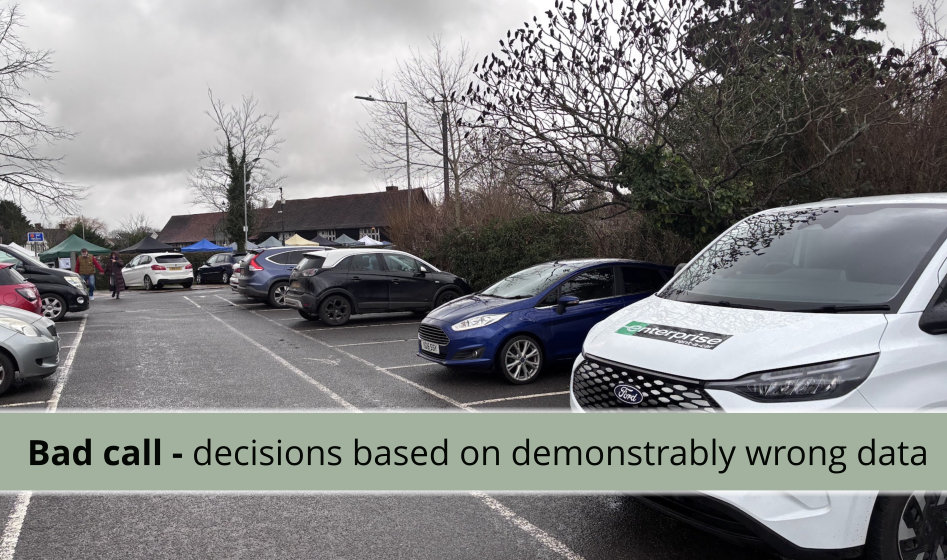
To make sound decisions – whether on multi-million pound budgets or local planning applications – a Council must rely on accurate, up-to-date evidence. Yet, we are seeing a recurring pattern where significant decisions in Hillingdon are being driven by data that is demonstrably wrong, cherry-picked, or simply does not exist.
This is not just a matter of differing opinions or careful selection of which other London Boroughs to compare ourselves against in press releases; it is a failure of basic competence that mirrors the “systemic weaknesses” and “unreliable forecasts” flagged by the Council’s own auditors. If the small details are wrong, how can we trust the big picture?
Lido surveys that simply never existed
In July 2025, Cllr Eddie Lavery cited “survey data” to justify refusing entrance fees for out-of-borough visitors at the Lido. However, an FOI response in November conceded that in reality, “no formal specific and targeted survey was carried out”. The Council instead relied on “informal” data from up-to 17-year-old HillingdonFirst cards, which ignore non-residents, bus users, and street parking displacement.
The Council’s reliance on flawed data persists despite their own Internal Audit team issuing a “No Assurance” rating – the lowest possible – to the Green Spaces service on 22nd October 2025. Minutes published today (2nd Feb) confirm that auditors found that significant management changes resulted in critical processes, like budget setting and savings programs, being left to “more junior and operational staff,” creating a “known area of risk” that the Council failed to properly address. Perhaps it will improve under Cllr Wayne Bridges, the new Cabinet Member for Community and Environment, who took up his position in December 2025. His predecessor, Cllr Eddie Lavery, now holds the Cabinet position for Finance, though.
The Kingsend Planning Debacle
The approval on appeal of a five-flat basement development on Kingsend exposes failings by the London Borough of Hillingdon. Kingsend has exceeded the Council’s own 10% limit on house-to-flat conversions for years, and a similar flatted scheme was recently refused on this basis. Yet at appeal, the Planning Inspectorate accepted a different calculation presented by the appellant, undermining the approach the Council had consistently applied.
More concerningly, Hillingdon confirmed in March 2025 that it was investigating high groundwater levels across the Ruislip area, with no known remedy or timescale – yet this information was not shared with the Inspectorate during the Kingsend appeal. As a result, a deep basement excavation was approved in an area where residents report subsidence, elevated water levels, and ground instability, and where a large TPO tree is to be removed, so far without these risks being fully assessed.
The CAB & St Martin’s Car Park
In a move that mirrors the Kingsend errors, the Council is proposing six houses on the St Martin’s Approach car park based on a perhaps conveniently flawed car parking survey. To justify a 32% reduction in parking spaces, the Council’s application claims that 36 existing spaces are “unusable.”
However, a January 2026 survey by the Ruislip Residents’ Association during a Sunday market- the first, and quietest of the year-found that every one of those “unusable” spaces was occupied. The RRA’s data showed that the actual number of cars exceeded the Council’s proposed new capacity of 81 spaces. By conducting their own survey on quiet weekdays in October and ignoring seasonal peaks, the Council has used selective data to justify a development that threatens the viability of the High Street and the Manor Farm heritage site.
The “Nonsensical” Road Closure
It sounds like the title of fairytale story but it’s more farce than comedy: most recently, we have the Breakspear Road South fiasco. A statutory notice was published to close the major arterial road for four months, causing immediate alarm. When we challenged it, the Council’s own Project Manager admitted the notice was “published in error” and that the official diversion “makes no sense.”
This wasn’t a draft scribbled on a napkin; it was a legal Statutory Notice published in the Uxbridge Gazette by Dan Kennedy, a Corporate Director. If the Council can sign off and publish a legal notice that its own officers admit is nonsensical, what checks are in place for other data used in budget setting or decision making?
If the inputs are broken, the output is failure. These four examples paint a picture of an administration that often decides on the policy first, and looks for the evidence later. When that evidence is missing (Lido), flawed (Kingsend/CAB), or nonsensical (Breakspear), they proceed anyway.
This connects directly to the wider financial crisis. If the Council cannot accurately count cars in a car park or verify a road map before publishing a legal order, how can residents have faith in the complex calculations behind the £150 million bailout? We are seeing the real-world impact of the “unreliable forecasts” that auditors warned us about: a governance culture where checking the facts seems to be treated as an optional extra.
If the input data is wrong, the decisions are wrong – and it is residents who pay the price for the clean-up.
9. Are they taking heed of the “Section 24” warnings?
External auditors issued a rare “Section 24” warning about systemic weaknesses. Instead of fixing the culture, the Council ignored the alarm bells. Is anyone actually listening? Read more…
Read more of our February 2026 series
- Introduction: Mistakes, misjudgements, or systemic breakdown?
- 1. The £150m Bailout: “Accounting Adjustments” vs Reality
- 2. The Culture of “Late”: From Accounts to Budgets
- 3. The “Theo’s Café” Scandal: Claims of cronyism and confirmed secrecy
- 4. The Silent Treatment: 12 Weeks and Counting
- 5. Putting Residents First? Not always
- 6. An addiction to “Special Urgency” – for secrecy or last minute work?
- 7. The secret £3.3m planning system
- 8. Decision-Making Based on Flawed Data
- 9. Are they taking heed of the “Section 24” warnings?
- Summary: The Case for Concern – is something broken at our Civic Centre?
- What Now? What do you think? You have until Wednesday to tell the Council

Comments are closed.