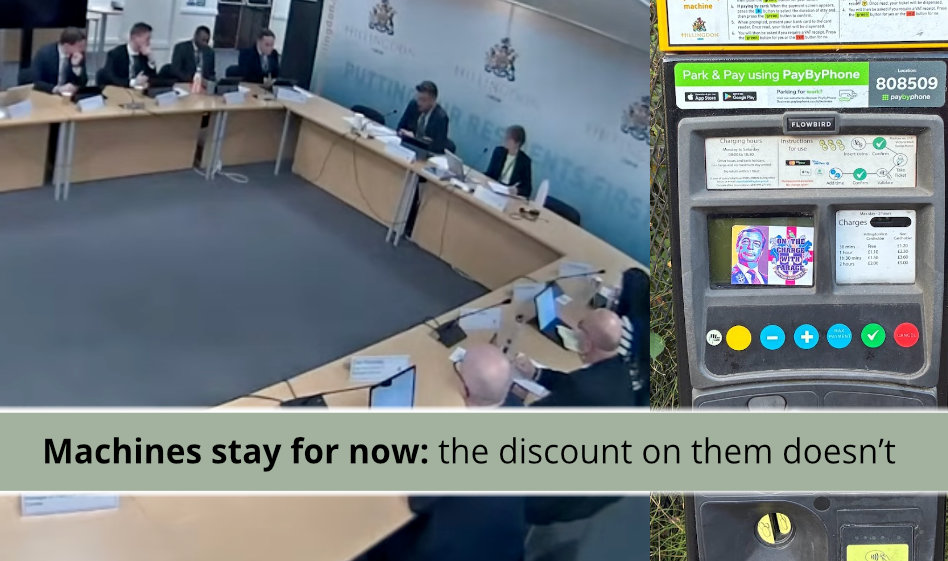
At Tuesday’s Residents’ Services Select Committee, officers told councillors there are “no specific proposals about removing any specific pay and display machines“, and that under the plans going to Cabinet “the machines and the ability to pay on a pay and display machine will … still remain“.
That’s welcome, and it’s a different tone from the September report that proposed consulting on “the primary principle guiding the removal of pay and display machines“. But a machine that stays isn’t the same as a machine that works for residents the way it does now. If Cabinet agrees the proposals on 17 December, a resident paying at a machine, with coins or a card, will pay the full rate and get no free half hour. Of the 307 residents who used our form to respond to the consultation, 85% pay at a machine.
This article is about the machines alone: how the Council has talked about them this year, what was said about them on Tuesday, what residents told the Council about them, and what we still don’t know. We’ve written separately about what else we learned at Tuesday’s meeting, and about everything else residents said in the consultation.
From a £95,000 budget saving to “no specific proposals” in November: how the Council has talked about ticket machines this year
- December 2025. The draft budget included a saving of £95,000 a year, for two years, from “changes to parking payment options“.
- July. At this same committee, Richard Webb, the Council’s Director of Community Safety and Enforcement, said around 300 machines were under review, and listed PayPoint shops among the ways to pay through PayByPhone. We reported it at the time.
- September. Report 1805, agreed by Cllr Wayne Bridges on 30 September, said the Council was “considering reducing the number of pay and display machines it provides“, potentially moving to pay by phone only in some areas. It proposed consulting on the principle that machines would be “reduced or removed where there are alternative means to pay for parking by cash or card and other than by phone or mobile application such as payment facilities in nearby shops“, and said the Council “is required to undertake a public consultation” before deciding. We set out the five proposals.
- 28 October. The Leader of the Council, Cllr Steve Tuckwell, told Barbara Fisher of the Uxbridge Gazette that machines in car parks are very expensive to provide, but that the Council had “listened to people’s concerns and are looking to maintain cash payments“, possibly by selling parking tickets in shops. He said the Council wants its car parks to be accessible to all residents. We asked what that meant for the resident rate.
- The same week. The consultation opened: 117 pages of legal notices covering three of the five proposals. Removing machines wasn’t one of them.
- 6 November. Officers told us that no machines had been identified for removal. Two Ruislip councillors, meanwhile, had told residents that the consultation did cover the principles for reducing the number of machines.
- 16 November. The report to the committee spoke instead of “a phased and targeted reduction in the number of pay and display machines“, with machines kept “where demand and accessibility requirements justify their retention“, and further consultation once specific changes are identified.
- 24 November. At the meeting, Mr Webb said each location would be looked at case by case, that mapping work is under way, and that there is no timetable.
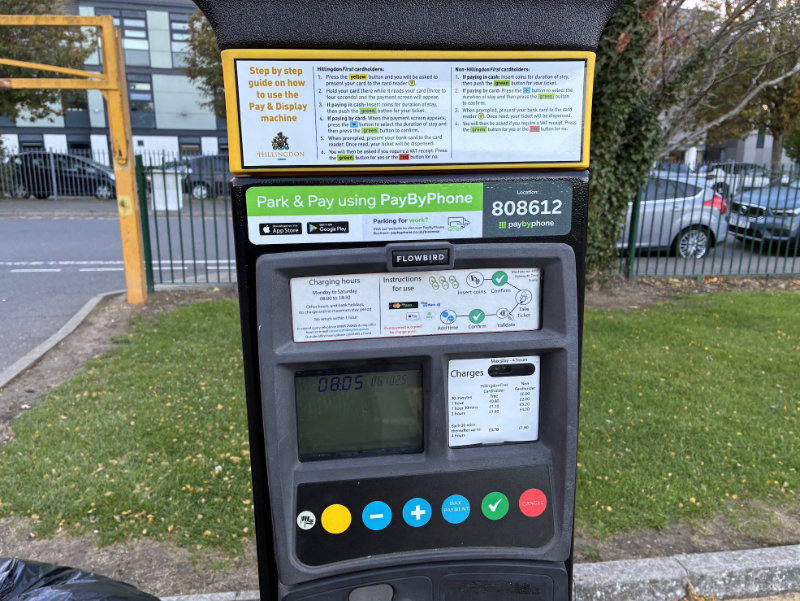
Some machines will be taken away, those that remain will require a registration plate number to be entered before a ticket can be bought
So “removal” has become “a phased and targeted reduction“, the principle residents were going to be consulted on never went out to consultation, and any decision about the machines themselves has moved to a later process with no date. The Council hasn’t said it has dropped the idea.
What officers and councillors said about ticket machines at Tuesday’s meeting, and why the most practical questions came from the chair’s seat
If you’d been asked on Monday which councillor would spend Tuesday evening standing up for the ticket machine outside the GP surgery, you might not have picked the Conservative chair of the committee. But it was Cllr Peter Smallwood who asked how paying in a shop would work with a queue at the till, who made a plea for the machines near GP surgeries and health centres, who told officers he’d have strong views about the Lido, who asked them to look at more than one day’s figures before deciding how much misuse there is, and who asked to see the equality impact assessment before any consultation on the machines. Residents had asked for every one of those things.
Cllr Daniel Singham, the committee’s Vice-Chair and an Eastcote councillor, asked whether any changes would be made location by location, using usage data for each machine and what alternatives are nearby, and whether ward councillors would be asked before a list is drawn up. Mr Webb said it was “going to be important that we look at each on a case-by-case basis“, that officers were mapping where machines are and what other ways to pay are nearby, and that “we will have to consult on changes for each location as they’re brought forward“.
Cllr Singham asks about each location; Mr Webb and Cllr Bridges reply
Cllr Bridges said there would be areas “where we can hopefully find a solution for paying by cash“, that shops had been mentioned as an option, and that “it’s all being looked into“. He said he’d be “very keen to ensure ward Members are consulted about the car parking provision in their wards“.
Cllr Tommy Balaam asked how older residents without smartphones would pay and still get their Hillingdon First discount. Mr Webb replied: “Nothing we’re proposing would actually require people to use a smartphone specifically.” In the same answer, he explained that “to get the discount, they’ll need to do a digital payment process“.
Cllr Balaam asks about residents without smartphones
Cllr Smallwood worried about paying in shops. If you have ten minutes to get a ticket, he said, and “there are three people in front buying stamps, a bottle of gin and cigarettes“, you could be waiting that long just to get to the counter. People were anxious, he said, about not being able to pay by phone, or “if we are getting rid of all the machines – which I’m hearing tonight potentially isn’t the exact outcome“.
Cllr Smallwood on queuing in a shop to pay
Mr Webb agreed that any proposal to remove machines completely would need its own consultation, “rather than the current proposals, which provide more of an incentive to use pay by phone“. He then made the case the Council has been making all year: many councils and private car parks already take payment only by phone or app, only a small proportion of people still pay cash, most pay by card, and nearly half of those using the Council’s parking pay by phone. Janice Noble, the Council’s Head of Transformation and Programmes, later told the committee that Enfield, Bromley and Harrow had gone cashless since 2022 or 2023, and Westminster in 2009.
Comparisons are only useful with boroughs like ours. Nobody said how the age profiles of Enfield, Bromley, Harrow or Westminster compare with Hillingdon’s, or how many of their residents can’t or won’t pay by phone, and nobody on the committee asked.
Mr Webb: the proposals provide “more of an incentive to use pay by phone”
Cllr Smallwood said he’d have “some strong views about keeping machines at the Lido“, and made what he called “a plea” about machines near GP surgeries and health centres, where older people are more likely to be parking, adding: “the doctor’s surgery is not there to hand out parking tickets“.
Cllr Smallwood’s plea for GP surgeries and health centres
When Cllr Kamal Preet Kaur, the committee’s Labour lead, asked when the next consultation would be, Mr Webb said it would be only on “specific changes which will result in significant changes to the availability of pay and display machines“, location by location. “There’s no timescale for that as yet,” he said. Officers need to finish the mapping, present initial analysis “for an informal steer“, and then prepare what they’re advised to go ahead with for consultation.
Cllr Kaur asks when the next consultation will be; Mr Webb: “no timescale”
The questions about ticket machines nobody on the committee asked, and the answers nobody challenged
Our preview, published the day before the meeting, set out 13 questions. On the machines, the committee asked about the Lido, GP surgeries, shops and the next consultation. Nobody asked:
- whether paying by card at a machine could keep the resident rate, when 44% of the residents who used our form pay that way;
- whether paying cash or by card in a PayPoint shop will get the resident rate and the free half hour;
- what the rules for registering for the resident rate will be;
- where the £95,000 a year saving from “changes to parking payment options” now comes from.
And some answers went unchallenged:
- Mr Webb said nothing being proposed would require people to use a smartphone. Nobody pointed out that, in the same answer, he’d said the discount would need “a digital payment process“.
- He said only a small proportion of people still pay cash, that nearly half pay by phone, and that “Jan has some of the data“. No figures were shown, and nobody asked for them. Of the residents who used our form, 13% pay with the PayByPhone app.
- Officers said the mapping of machines against nearby shops is being done now. Nobody asked why it wasn’t done before the Council proposed consulting on the principle for removing them, or why residents will now be consulted twice.
Labour’s two members, Cllr Kaur and Cllr Navnit Dhesi, chose to spend most of their questions on the misuse figure, the extension of the consultation, Sunday charges in Hayes and whether decisions could be reversed. They were fair questions, and Cllr Kaur deserves credit for pressing officers on the one-day misuse figure. But apart from Cllr Kaur’s question about the next consultation, they chose not to ask about the machines, and chose not to come back on any of the answers above.
Cllr Paul Capps, Reform UK’s only member on the committee, didn’t speak at all during the item. Not a question about the Lido, the GP surgeries, the shops or the cash, on the one evening councillors looked at a consultation 333 residents had responded to.
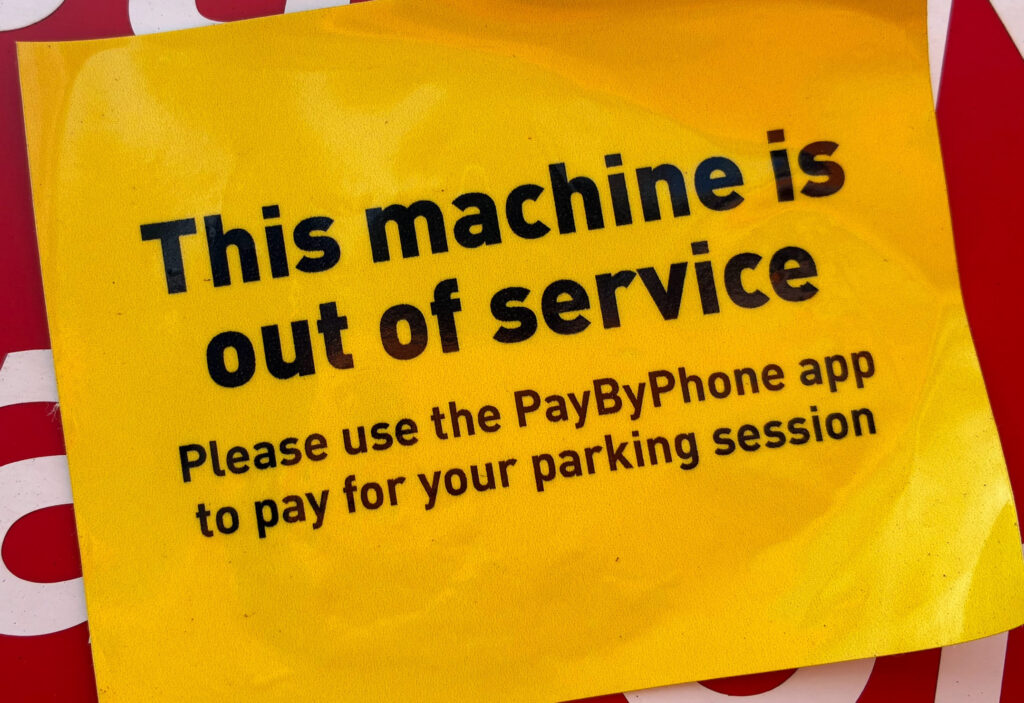
They might be left out on the streets, but how many machines are out of service at any one time?
The machines will stay, but if Cabinet agrees, from next year they’ll be the dearer way for residents to pay
In November, officers confirmed that “cashless“, in these proposals, means any payment other than at a ticket machine. Paying by bank card at a machine doesn’t count. So the coins in your purse will still work at the machine, but at the full rate, and with no free half hour. A third of the residents who used our form (34%) asked the Council to count a card payment at a machine.
The Council has reasons, and they’re worth setting out fairly. Report 1805 says some people use the free half hour back to back to park for longer, and that the machines can’t take a number plate and check that a driver is a resident at the same time. On Tuesday, Mr Webb said a limit on free sessions was “introduced only at the beginning of November” on PayByPhone, but can’t be set on the machines. Some residents told us they rarely carry cash now:
“Sometimes with cash but since cash is less readily available now I would usually use a card.” – a resident in Ickenham and South Harefield
“I have no objection to making cashless payments as such, but this currently incurs a ‘processing charge’ which increases the parking charge, to an amount above the published figure.” – a resident in Ickenham and South Harefield
But for many, the machine is the only way they pay:
“I won’t be able to park anywhere if I can’t use cash. I do not have a smart phone and if I did I would never store card details on it.” – a resident in Hillingdon West
“My husband … has very bad arthritis and using keypads is very difficult – he often makes mistakes as his fingers are bent and crooked. I fear he will not be able to park if coins are not allowed.” – a resident in Ickenham and South Harefield
“By all means have this app as another option for payment, but the current system works effectively.” – a resident in Ruislip
One resident in Ruislip suggested a way through: “Keep all machines but make them cashless but with the resident discount via the Hillingdon First card to save costs on cash collection from machines.”
Why keeping machines “where demand justifies them” could end up counting against the machines, once the resident rate has gone from them
Mr Webb described the current proposals as providing “more of an incentive to use pay by phone“. That’s the point of them. If they work, residents who can switch will switch, fewer people will use the machines, and a test based on “demand” will find fewer machines are needed.
The Council could fairly say that’s just following the choices people make, and that location-by-location decisions using real usage figures are exactly what residents and councillors asked for. We agree the evidence should decide. Our question is which evidence, and when. Usage measured after the resident rate has been taken off the machines would tell you mostly that the incentive worked. Usage measured now, while residents can still choose freely, would be a fairer starting point, and 12% of the residents who used our form asked the Council to publish the usage and running cost of every machine.
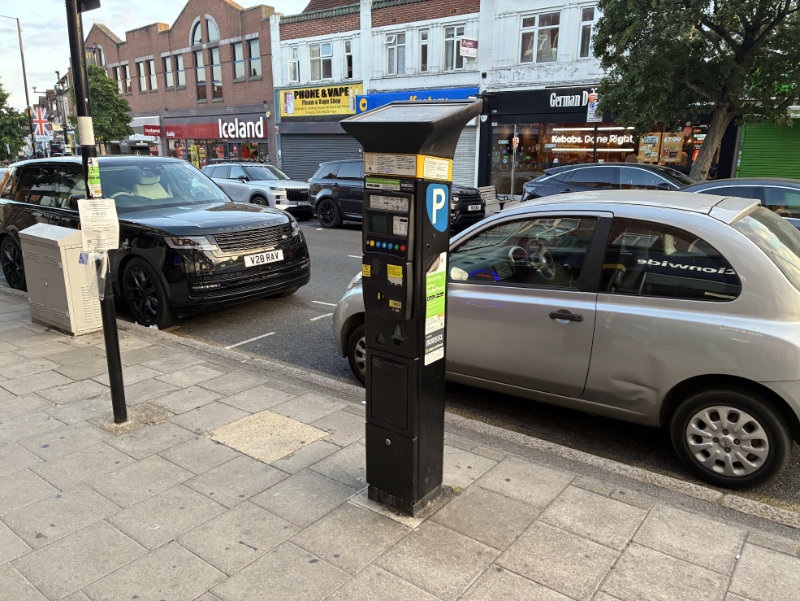
A ticket machine on Ruislip High Street. For now…
What residents told the Council about ticket machines, even though officers said removing them wasn’t part of the consultation
Officers said removing machines wasn’t in this consultation. Residents commented on it anyway. Of the 307 who used our form, 92% ticked at least one point about removing machines, and almost all (98%) kept our opening line saying they were commenting on the principles for reducing machines, so their views would be on record. More than a third asked for machines to be kept at the Lido (36%), and as many at GP surgeries and health centres (37%). Six in ten (59%) asked for one or the other.
None of the eight themes Ms Noble listed on Tuesday was about removing machines as such. The nearest was “payment options and reliability“.
On GP surgeries and health centres:
“I use this machine as it is my GP’s. I am 82 years old.” – a resident in Ruislip Manor, on the machine at Abbotsbury Gardens in Eastcote
“One can often be kept waiting over half an hour before being called for the appointment.” – a resident in Eastcote
“Special arrangements need to be made here to allow those elderly and other patients unable to use apps to pay for their parking using cards or/and cash in existing machines.” – a resident in Ruislip
On the Lido:
“I will not be able to go there if this method of payment is taken away.” – a resident in Ruislip
“Has the council checked that there is a good phone service at all the locations they are looking to remove the machines?” – a resident in Ruislip
There’s a practical problem here too, and anyone who has tried it will know it. In many of the Council’s car parks, the location code you need to pay by phone is on only a couple of signs, so you end up walking to a corner of the car park with your phone in your hand to find it, and the app’s location finder often doesn’t pick up the car park at all. Four in ten of the residents who used our form (40%) said they don’t feel safe using their phone in a car park.
“They cannot identify the location code and it’s very difficult to pay or extend from the app.” – a resident in Ruislip
And from those who weren’t against change altogether:
“Removal of ticket machines by Ickenham shops could work, if shops are involved to help visitors or locals? Changes are a part of life. Can’t help feeling the removal of ticket machines might be the wrong way to go.” – a resident in Ickenham and South Harefield
“I do not know how I will pay for parking if cash is not accepted at the machines and the number of machines is also reduced … This is making me anxious.” – a resident in Eastcote
Paying in shops: the Leader’s promise, a PayPoint service that’s “not in place yet“, and a question nobody has yet answered
Cllr Riley Russell asked what paying in shops would look like, calling the report’s wording “very vague“. Mr Webb said the Council’s PayByPhone provider works with PayPoint, and that a change had been started so people could pay for parking in a PayPoint shop. “That’s not in place yet, but it will be shortly,” he said. It would offer a way to pay “using a card or cash, without actually having to go to a pay and display machine“. In July, he’d listed PayPoint shops among the ways to pay.
Cllr Russell asks about paying in shops; Mr Webb: PayPoint is “not in place yet”
Residents welcome shops as an extra way to pay, but not as a replacement (16% asked for exactly that), and many asked what “nearby” means (13%):
“If payment was permitted at a shop, this would not work in Eastcote. By the time I had got to the shop, obtained my ticket and got back to the car, 20 minutes would have already passed.” – a resident in Eastcote
“Ruislip High St is quite long so paying in a particular shop for parking could involve a long (when you are old) walk.” – a resident in Ruislip
“Where does the council suggest a ‘nearby’ shop for payment is going to be there?” – a resident in Hillingdon East, on the Lido
The question nobody has answered is the one 9% of residents asked: would a resident paying cash in a shop get the resident rate and the free half hour? The draft orders say the resident tariff “can only be accessed if the cashless payment account is linked to a registered Hillingdon Resident“, and the registration rules are still being written. It wasn’t asked on Tuesday. Until it’s answered, we can’t tell whether the Leader’s promise to keep cash payments includes the resident rate, or only the right to pay the full one.
Cllr Smallwood also asked about Enfield’s scratch cards, which residents can buy and keep at home. Ms Noble said “it’s definitely possible to do something innovative such as a scratch card“.
Cllr Smallwood asks about other boroughs and Enfield’s scratch cards
The Beck Theatre, where parking is phone-only now, and what residents asked the Council to tell them about it
There’s one place in the borough where you can already see what phone-only parking looks like: the Beck Theatre in Hayes. In her interview with the Leader, Barbara Fisher put to him that older theatregoers at the Beck, some without smartphones or any mobile at all, are upset that they can’t buy a ticket at a machine. His answer was the promise about cash and shops.
The Beck wasn’t mentioned on Tuesday. Our form asked the Council to publish what it found there – how many people struggled to pay, how many paid the full rate, how many were fined – before extending the idea anywhere else. It’s the nearest thing the Council has to evidence of what a machine-free car park does to the people who use it.
The £95,000 a year saving from “changes to parking payment options“, and the question of where it now comes from
The saving was in the draft budget published in December 2025, long before any consultation. Cllr Kaur asked about it at this committee in July. Report 1805 said consulting had “no direct financial implications” and that any savings would be “evaluated following consultation and reported to Cabinet“. In November, officers told us the savings were “forecast savings assumptions“.
If no machines are coming out soon, the Cabinet papers should say where the £95,000 now comes from: fewer machines later, less cash to collect as people switch to their phones, or more residents paying the full rate at the machines.
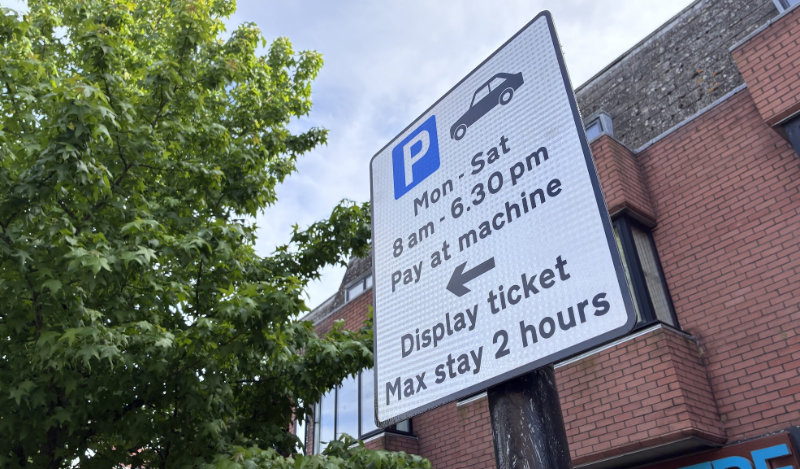
Ruislip High Street had new signs this year, instructing ‘Pay At Machine’. WIll they need replacing?
A big job with no timetable: around 300 machines, a consultation for each location, and ward councillors to talk to
What officers described on Tuesday is a lot of work: mapping around 300 machines against the shops and other ways to pay near each one, an informal steer from the Cabinet Member, a public consultation for each location, and, if Cllr Bridges follows through, talking to the councillors for every ward affected. There’s no date for any of it.
There are two ways to read that. The generous one is that this is the careful, local, evidence-based approach residents asked for, and it’s worth noting that the questions about the Lido, GP surgeries and ward councillors came from the Conservative side of the committee. The less generous one is that it moves the unpopular part of the plan out of the weeks when residents are paying attention, and that by the time it comes back, the 17 December decision will already have changed the usage figures it’s judged on. Readers can decide for themselves. We’ll be watching what happens to the machines.
What happens next: the Cabinet papers by 9 December, the decision on 17 December, and the questions we’ll be asking
The Cabinet papers, including the officers’ analysis of the 333 responses and the equality impact assessment, must be published by Wednesday 9 December, five clear working days before Cabinet meets on Thursday 17 December. When they’re out, we’ll be looking for answers to these questions:
- Will a resident paying cash or by card in a PayPoint shop get the resident rate and the free half hour?
- When will PayPoint payments start, and which shops will take them?
- Where does the £95,000 a year saving from “changes to parking payment options” now come from?
- Will the Council publish the usage and running cost of every machine now, before the resident rate comes off them?
- Will it commit to the principle in its own report: that no machine goes where there’s no other way to pay by cash or card nearby?
- Will machines at the Lido, at GP surgeries and at health centres be kept, as the Chair asked?
- Will each location’s consultation be a public one that residents are told about, not only a conversation with ward councillors?
- What did the Beck Theatre trial find?
The consultation has closed, but you can still email Cabinet members before 17 December. After Cabinet decides, the decision can be called in by a majority of the Residents’ Services Select Committee.
Read what else we learned at Tuesday’s meetingOpen - Where our facts and figures come from - always keep the receipts
- Residents’ Services Select Committee, 24 November 2026: agenda item 7 and the committee report. The webcast of the meeting; quotes are from our transcript, with times from the start of the stream.
- Cabinet Member decision 2026/1805 and the report behind it, paragraph 4.4 and the financial implications, September 2026
- Notice of proposals and draft traffic orders, reference 3N/04/21/10/26, 21 October 2026: our coverage
- The Council’s answers to our questions, 6 November 2026: published in full
- Residents’ Services Select Committee, July 2026: our transcript of Richard Webb’s answers
- Draft budget 2026/27: the parking savings
- Uxbridge Gazette, 28 October 2026: Cllr Tuckwell’s interview with Barbara Fisher in her Bm@il column, and our coverage of the Leader’s comments
- 307 responses sent through the RRA’s consultation form, 8–11 November 2026. Each point is counted only where the resident ticked it. Residents’ quotes are their own words, not our suggested wording; we’ve tidied spelling only.


Comments are closed.