
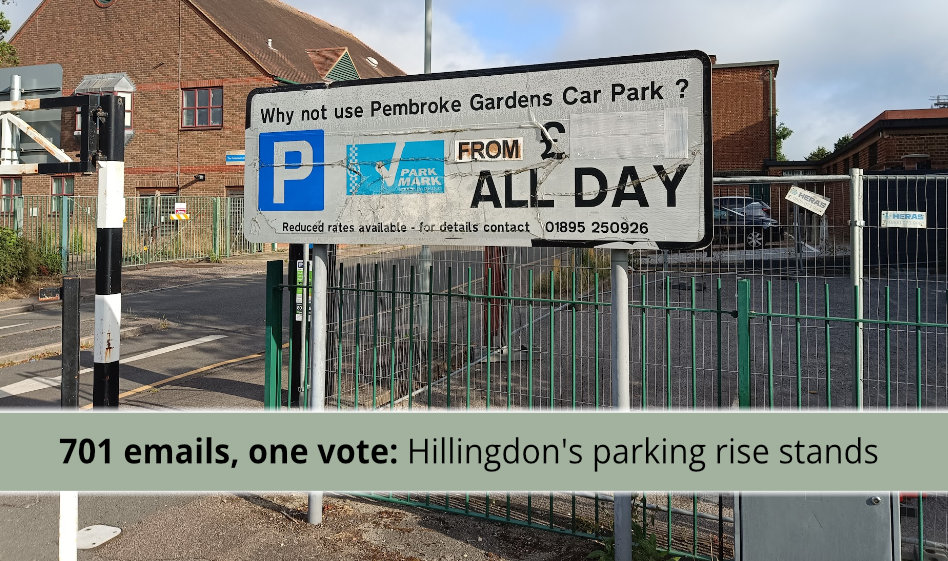
In October, residents sent 701 emails through our forms about the rise in resident parking charges: 323 to the Cabinet before it voted, and 378 afterwards to the Audit, Finance and Performance Committee, asking it to call the decision in.
Cabinet approved the rise unanimously, without mentioning any of them. A call-in needed three of the committee’s five councillors, and only one, Labour’s Cllr Tony Eginton, supported it.
What Cabinet approved: about 15% more for visitors, and about 73% more for residents
On 22 October Cabinet approved the Council’s discretionary fees and charges for 2027/28. Most go up by about 15%. For Hillingdon First cardholders, parking goes up by 71% to 77% in most places, because the resident discount is cut from about 40% to about 10%.
- An hour on-street goes from £1.50 to £2.60, and two hours from £3.30 to £5.70.
- Two hours at St Martins Approach goes from £2.80 to £4.90.
- More than three hours at the Lido in summer goes from £11.20 to £19.30.
- The free half hour stays, and so do the three free hours for residents at the Lido.
It’s the second rise in a year. Before April, an hour on-street cost a resident £1.10. Other new fees and charges start in January, but Cabinet was told the parking charges take effect in April 2027.
“This is not a consultation paper. This is a decision paper”
That is how the Cabinet Member for Finance, Cllr Eddie Lavery, introduced the report. He told Cabinet that “parking charges will rise by 15%, with the resident discount reduced from the current approximately 40% to 10%“, and that “it is still only £2.60 to park for an hour, and if you only want 30 minutes, that is still free.”
He acknowledged that “there will be some resident concerns in respect of this, but we do need to move from where we are now“, and pointed out that “the resident discount rate is something that is almost unique to Hillingdon“. He also said that “the majority of our parking, from the data we have, is for short periods and for residents“. The report contained no such data.
Before the vote: 321 residents wrote to the seven Cabinet members in three days
Our form opened on Tuesday 20 October, two days before the meeting, and 180 emails went on the first day. Each went to all seven Cabinet members, with a copy to the resident’s ward councillors. Residents could choose up to six reasons. Harm to local shops and high streets was the most chosen, by 73%, followed by the gap between residents’ 73% rise and everyone else’s 15% (69%), and the lack of any public consultation (61%).
Open - The reasons residents gave the Cabinet
| Reason | Residents | Share |
|---|---|---|
| Harm to local shops and high streets | 234 | 73% |
| Residents face about 73%, non-residents about 15% | 220 | 69% |
| No public consultation | 196 | 61% |
| The HillingdonFirst discount cut from about 40% to about 10% | 164 | 51% |
| Effect on town centres not assessed | 158 | 49% |
| A steep rise on top of an earlier one | 116 | 36% |
| Older people, disabled people and carers | 98 | 31% |
| Cost of living | 93 | 29% |
None of the Cabinet members mentioned the residents who had written to them. The Deputy Leader, Cllr Richard Mills, told the meeting: “We’re all local residents ourselves. We, as individuals, are not immune from these charges.” Later that evening, the Leader, Cllr Steve Tuckwell, said the Council must “explain our choices very clearly to residents – and we’ve done some of that tonight – and listen to the people that are affected, and we’ve done that as well.”
What the Council’s own consultants had warned
The only background paper to the Cabinet report was a review of fees and charges by consultants, the Lyon Local Government review. The Council says it was on its website, but the report didn’t link to it until we asked, and the link appeared on 19 October, three days before the meeting.
The review gives the Council a case, and it’s fair to say so. It found residents pay about half what drivers pay on-street in comparable outer London boroughs, and that “it is uncommon to offer a residents discount for parking“. But it also warned that cutting the discount “will cause significant negative public reaction” and “could be phased over a number of years“, and it assumed residents would park 10% to 20% less as a result. Even a 25% rise, it said, “would be an outlier” that “would need to be led by traffic management policy“.
It modelled each option “on the basis of those being the only ones implemented“. Cabinet combined a general rise with a cut in the discount, in one step, and that is how residents end up paying about 73% more. Summing up, Cllr Tuckwell said the proposals “take account of that evidence alongside market conditions and the effects on demand“, but no analysis of the combined effect on demand was published.
The same review is where the plan to make the free half hour phone-only began, on the strength of “strong anecdotal evidence of ticket abuse“.
After the vote: 376 residents asked five councillors to call it in, and one did
Residents can’t call in a Cabinet decision; only councillors can. For fees and charges, that means a majority of the Audit, Finance and Performance Committee: three of its five councillors, as its independent Chair doesn’t vote. A call-in would have put the decision on hold until the committee had met to examine it, within 10 working days.
The deadline was 5pm on Friday 30 October. That week, 376 residents used our form to email the committee’s members: Cllrs Ekta Gohil (Northwood), Jonathan Bianco (Northwood Hills), Daniel Singham (Eastcote), Peter Smallwood (Ruislip) and Tony Eginton (Pinkwell). The four Conservative members did not support a call-in. Cllr Eginton, the one Labour member, did, so the decision stood.
In May, CIPFA’s review of the Council found that its scrutiny committee “appears to act more on the basis of party-political lines rather than on trying to determine whether policies or decisions reflect good governance or value for money“. The committees have been reorganised since then.
This time we asked residents how the rise would affect them, as well as why they objected. More than half said they were stretched by the cost of living, needed to park for longer than the free half hour, or would shop elsewhere. Their top reasons were the 73% rise for residents and fewer customers for local shops, each chosen by 77%.
Open - How the rise would affect residents, and why they asked for a call-in
| How the rise would affect them | Residents | Share |
|---|---|---|
| I am stretched by the cost of living | 202 | 54% |
| I need to park for longer than the free half hour | 200 | 53% |
| I will shop elsewhere | 195 | 52% |
| I visit several shopping parades in one trip | 153 | 41% |
| I am over 65 | 137 | 36% |
| I do not use a smartphone or the pay-by-phone app | 77 | 20% |
| Reason | Residents | Share |
|---|---|---|
| The rise for residents is about 73%, not 15% | 291 | 77% |
| Fewer customers for our shops and high streets | 291 | 77% |
| Prices were set before residents were asked | 207 | 55% |
| No analysis of the effect on local shops | 195 | 52% |
| More cars on residential streets | 173 | 46% |
| How will residents be able to object to the traffic orders? | 110 | 29% |
| The legal basis and purpose need checking | 108 | 29% |
97 residents asked why the prices had to be fixed in October when they don’t change until April. At the Cabinet meeting, the Interim Chief Finance Officer, Pete Carpenter, said deciding now “gives us plenty of time to implement, even if we have to implement as late as the 1st of April“.
Judged against the Council’s own priorities
Five weeks before the vote, Cabinet adopted its priorities for 2026–2030. Three of its commitments, under three of its six priorities, sit uneasily with how this decision was made.
- Putting our residents first: “Listening to your views to shape what we do.“ The prices were set in “a decision paper“, with nobody asked, and the 321 residents who wrote before the vote went unmentioned.
- Easy to deal with: “Giving you clear, and accessible information.“ The headline was 15%. For residents, it’s about 73%.
- Open for business: “Revitalising your town centres.“ The report marked “Open for business” as not applicable, yet shops and high streets were residents’ first concern on both forms.
CIPFA, the public finance body that reviewed the Council for the government in May, makes part of the Council’s case for it: the Hillingdon First card is “the type of discretionary spend other authorities have made efficiencies on“, and Hillingdon’s fees and charges haven’t kept up with other outer London boroughs. But CIPFA also found a council without an overall plan, with “the voice of the resident also absent“.
Mostly different people each time
Across our three forms – to Cabinet, to the committee and to the parking consultation – we received emails from about 918 different email addresses. Only about 30 were used on two of the forms, and 6 on all three.
In their own words
“I have lived in Eastcote since 1968. I’m now elderly, and I shop frequently in Eastcote… My income as a pensioner is limited, and increased parking fees will result in less money to spend on food.” (Eastcote)
“I live in Ruislip and the free half hour means I go to Eastcote or Ruislip when I need to buy something outside the weekly grocery shop. It’s so convenient. I will just drive a little further to Pinner if I have to pay.” (Ruislip)
“I have just retired. I look after my grandson 2 days a week… Please please keep at the very least half an hour free.” (Ruislip Manor)
“I regularly make several stops to visit different shops in places like Ruislip, Ruislip Manor and Eastcote. If the charges go up I just won’t bother to visit these shops.” (Ickenham and South Harefield)
“Our only time out each week is shopping at Eastcote Boots and then a cuppa at Costa. We need an hour to do both thanks to my disability.” (South Ruislip)
“To have the Hillingdon First card discount reduced by so much I feel is an insult.” (Ruislip)
What happens now
The new prices start in April. Cabinet decides on 17 December on the separate consultation, about how residents reach the resident rate, and the Residents’ Services Select Committee looks at it first, on Tuesday 24 November (our preview). The draft traffic orders in that consultation, published on 21 October, set out the prices Cabinet replaced the next day.
If the new prices change where or how often you park, or you run a business and see a change in trade, we’d like to hear from you. Email secretary2@ruislipresidents.org.uk or get in touch here.
Open - Where our facts and figures come from - always keep the receipts
- 323 emails sent through the RRA’s Cabinet form, 20–22 October 2026, and 378 through the RRA’s call-in form, 26–30 October 2026. Each reason is counted only where the resident ticked it, and once per resident.
- Cabinet meeting, 22 October 2026: agenda and video, including item 7, Discretionary Fees and Charges 2027/28
- Lyon Local Government review of Hillingdon fees and charges, the background paper on the Council’s agenda page
- Our article on the price rise, 18 October 2026, with every resident price now and from April
- Our article on the 2026/27 budget, January 2026, with the prices before April
- Audit, Finance and Performance Committee membership
- CIPFA, Hillingdon Council External Assurance Review, May 2026: our coverage, with the full report
- Council Priorities 2026–2030


Comments are closed.