
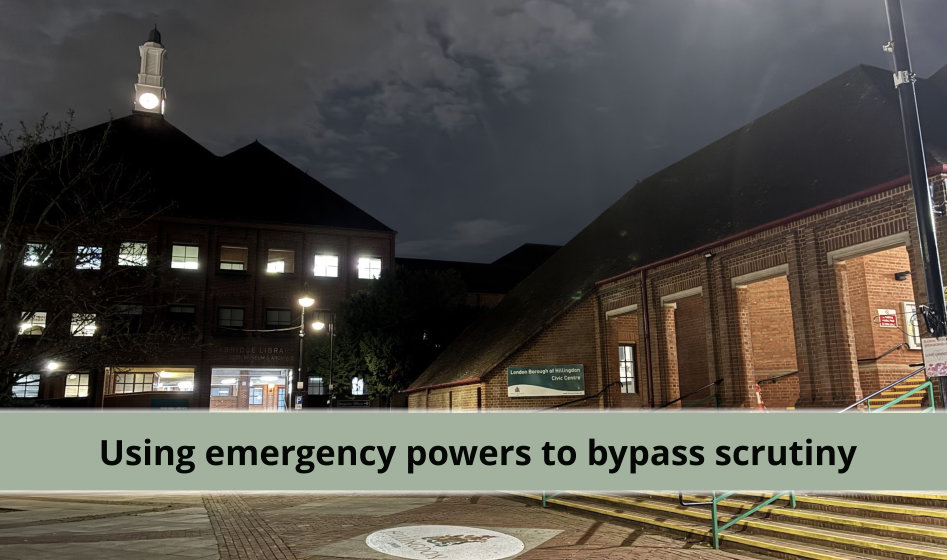
Most residents know when their home insurance is due; they shop around in good time. Yet for the second year running, the Council has used “Special Urgency” powers to renew the Council’s insurance policy at the last minute in November, automatically waiving the usual scrutiny period.
What does “Special Urgency” actually mean?
Special Urgency is an emergency power that allows the Cabinet to make a decision immediately, bypassing the usual 28-day notice and – crucially – removing the right of Councillors to “call-in” (scrutinise) the decision.
The Constitution states this should only be used where a decision “cannot reasonably be deferred” and where delay would seriously prejudice the Council. It is intended for genuine crises – not predictable annual events. When used, the detailed report is often classified “Part II” (Private), meaning residents see only a headline, while the background, cost options, and justification are hidden.
In the case of the insurance renewal, the decision was deemed urgent simply because the existing policies were “due to expire” – an annual, predictable event known well in advance. A foreseeable renewal is not an emergency; treating it as one is poor management.
Christmas as an “Emergency”
The same approach has been used elsewhere. In September 2025, the Council approved the Christmas Lights 2025 programme using Special Urgency procedures, again disapplying scrutiny and call-in. While the headline decision was published, the reasons, options considered, and justification were contained in a Part II confidential report, explicitly withheld from residents on the grounds of “commercial sensitivity.”
But Christmas does not arrive by surprise. Neither does Diwali. Both follow fixed annual cycles, with ample time for proper procurement, transparency, and democratic oversight.
Panic Spending: The Grant Thornton Contracts
They used this same “panic” tactic in April 2025 to award a huge contract to Grant Thornton without a tender. The value of that single award was £733,650. Since then, further sums have been awarded—£746,850 to continue Phase 2 of that same work, and an additional £357,200 to complete the first Phase that couldn’t be done inside the first contract.
This totals over £1.8m in less than a year, all without tenders. We asked why payments for these services do not appear on the Council’s published list of spending over £500 in our questions to the Deputy S151 Officer (see point 4 above)… but we have received no answer.
Why this matters
This pattern matters because Special Urgency is not a neutral shortcut. Its use means no advance notice, no scrutiny committee review, no opportunity for call-in, and only a brief public decision notice—with the substantive reasoning hidden. When emergency powers are repeatedly used for routine, calendar-driven decisions (like festive lighting) or massive financial outlays (like the Grant Thornton contracts), the effect is to normalise decision-making without scrutiny and to exclude residents from understanding how and why money is being spent.
7. The secret £3.3m planning system
Why did Hillingdon spend £3.3m on a new IT system in secret, while other councils paid a fraction of the price? The details were hidden from the public. Read more…
Read more of our February 2026 series
- Introduction: Mistakes, misjudgements, or systemic breakdown?
- 1. The £150m Bailout: “Accounting Adjustments” vs Reality
- 2. The Culture of “Late”: From Accounts to Budgets
- 3. The “Theo’s Café” Scandal: Claims of cronyism and confirmed secrecy
- 4. The Silent Treatment: 12 Weeks and Counting
- 5. Putting Residents First? Not always
- 6. An addiction to “Special Urgency” – for secrecy or last minute work?
- 7. The secret £3.3m planning system
- 8. Decision-Making Based on Flawed Data
- 9. Are they taking heed of the “Section 24” warnings?
- Summary: The Case for Concern – is something broken at our Civic Centre?
- What Now? What do you think? You have until Wednesday to tell the Council

Comments are closed.