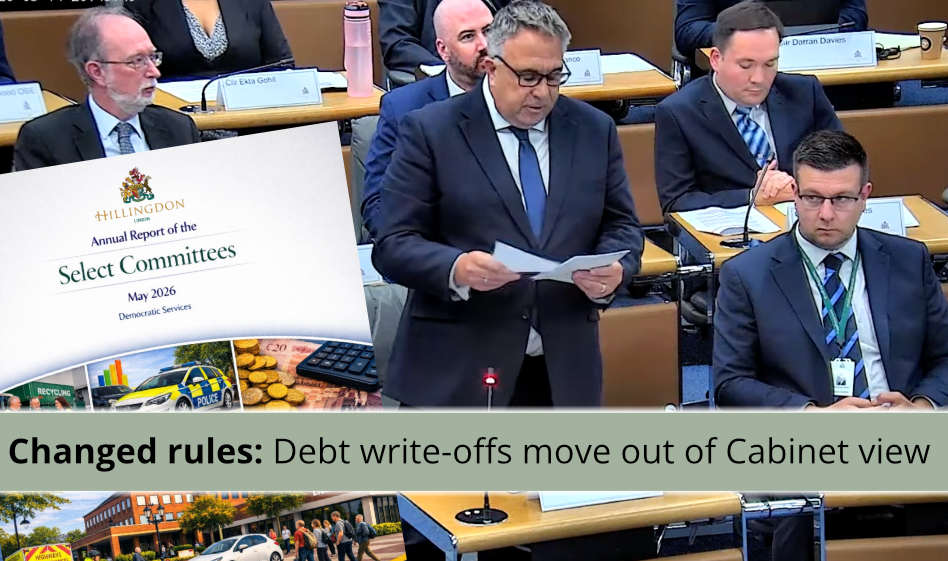
From constitutional changes to closed-door decisions: how the Council reacted to a local scandal.
This article is not about whether the Theo’s Café lease was lawful or unlawful. It is about what Hillingdon Council did next.
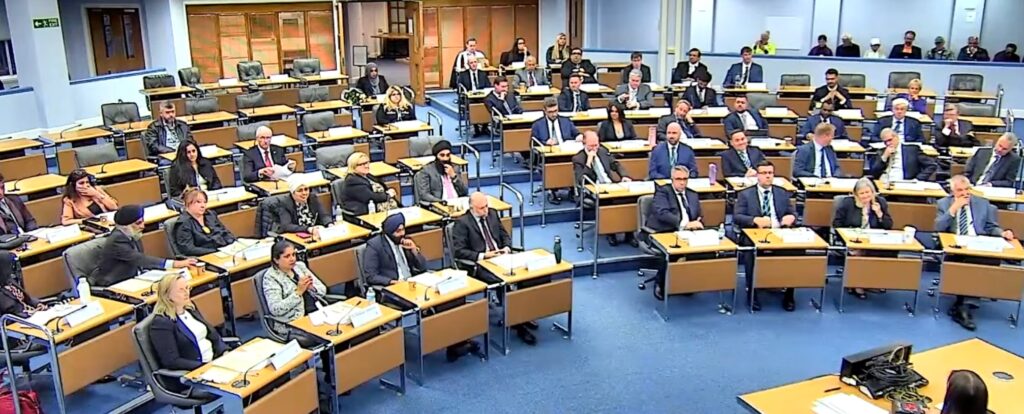
At the Annual Council meeting on 14 May 2026, the newly re-elected Conservative administration approved a package of major constitutional changes. Those changes included removing elected councillors from the process of sealing contracts, and radically altering the rules for writing off individual debts.
The Council calls this modernisation. Residents are entitled to ask whether it is also a reaction to Cowley Meeting Hall.
Removing councillors from contract signatures
The January 2023 Cowley Meeting Hall lease was executed under the Council’s Common Seal. Councillor Peter Smallwood attested the Council’s seal.
When residents questioned why elected councillors were involved in signing property documents connected to a former Conservative councillor, the Council defended the process as proper and constitutional.
Then, at the first Annual Council meeting after the elections, the Council changed that Constitution.
The report described councillor involvement in sealed legal documents as a “historical legacy” and recommended removing elected Members from the process. The minutes confirm the Constitution was amended “to remove reference to elected Members when executing contracts with the Common Seal of the Council”.
So residents are entitled to ask: if the old system was perfectly satisfactory, why remove councillors from it now? That is not an accusation. It is the obvious question.
Moving half-a-million-pound debts out of public view
The second change is even more troubling. Before 14 May, individual debts of £50,000 or more had to go to Cabinet for a formal democratic decision.
Under the new system, debts from £5,000 to £500,000 can be written off by the Corporate Director of Finance, in consultation with the Cabinet Member for Finance, through a published Chief Officer Decision Notice. Only debts above £500,000 now go to the Cabinet Member for Finance for a formal democratic report.
The Council says this will simplify the process. But this change was not debated in a vacuum.
Councillors speaking against the motion raised concerns about the proposed changes to debt write-off delegations “following the issues that had arisen in relation to the Cowley Meeting Hall”.
That matters. Cowley Meeting Hall became a public issue precisely because residents were asking how a discounted lease, private occupation, arrears and possible write-off had been handled.
The Council’s answer, weeks later, was to approve rules under which future write-offs below £500,000 no longer need to go to full Cabinet. That may be lawful. It is not reassuring.
The Voting Record
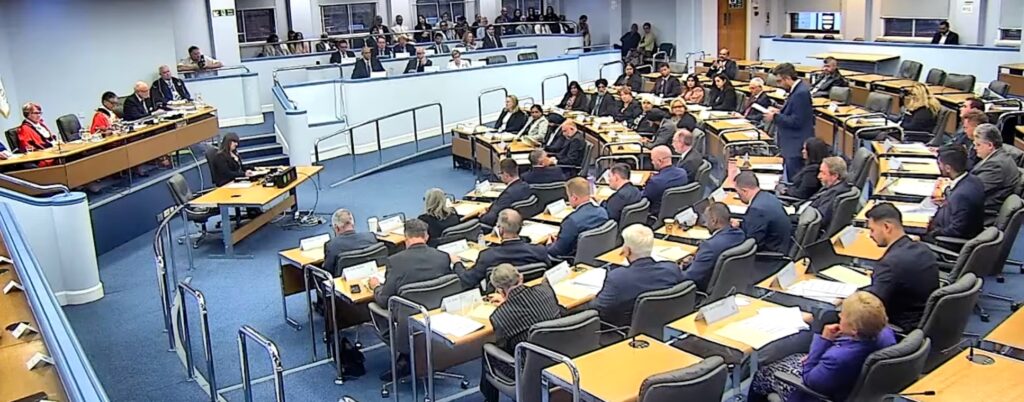
The vote was recorded. The minutes show that Councillor Peter Smallwood voted for the constitutional package. So did Councillors Jonathan Bianco and Darran Davies, both of whom feature in the wider Cowley Meeting Hall story. Councillor Bianco was the relevant Cabinet Member when the original lease renewal was approved. Councillor Smallwood attested the Council’s seal on the lease. Councillor Davies witnessed Alan Deville’s signature.
The recorded vote also shows the Reform UK councillors supported the changes, while Labour councillors and Green councillor Sarah Hassoun voted against.
That does not prove wrongdoing. But it does mean that councillors whose names appear in the Cowley Meeting Hall documentary trail also voted for constitutional changes affecting sealed contracts and debt write-offs. Residents are entitled to notice that.
A public asset was leased at a heavy discount. A private café arrangement followed. Rent arrears became controversial. Residents asked for the records. The Council missed the FOI deadline. Then, before providing the answers, the Council changed the rules on sealed contracts and debt write-offs.
That sequence is enough to justify public concern. The Council may argue that these changes are routine administrative improvements. But when a Council changes the rules shortly after a public controversy exposes weaknesses in how property, leases, arrears and write-offs are handled, residents should not be expected to nod politely and move on.
The Theo’s Café contradiction began with one question: what did Cabinet approve, and what was actually signed? The Council has still not answered that properly. Instead, it has changed how contracts are sealed and changed how debts can be written off.
The next question is just as important: has Hillingdon strengthened accountability – or made awkward financial decisions easier to move away from full public view?
Read More
- The illusion of engagement: Stolen credit, slashed scrutiny, and refused handshakes
- Theo’s Café Update: A missed deadline, an ICO investigation, and a Police report
- After Cowley Meeting Hall: Hillingdon rewrites the rulebook to move debt out of sight
- Fewer eyes on the money: Why residents should challenge Hillingdon’s new scrutiny system

Comments are closed.