
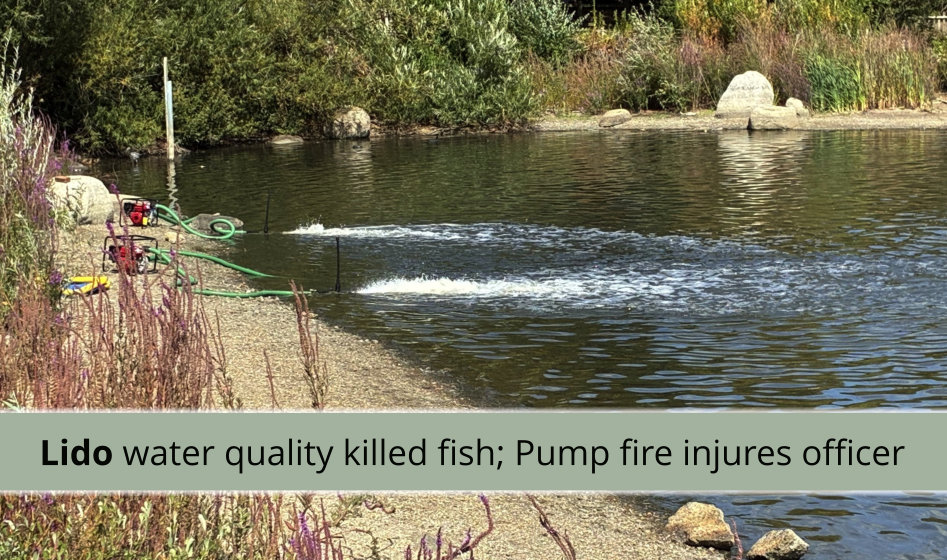
Ruislip Lido has had a difficult few weeks. First an oxygen crash killed a significant number of fish. Then, while the Council and the Environment Agency worked to put that right, one of the emergency pumps caught fire, and a Council officer was taken to hospital. Since then, the information coming from Hillingdon Council has gone from detailed to almost nothing, right at the point the questions became harder to answer.
Here is what we know, and how we know it.
How an oxygen crash killed fish at the Lido, and how the ward responded early on
In the last week of August, residents walking round the Lido began finding dead fish washed up along the shoreline: perch, pike, and at least one eel among them. The Environment Agency attended, tested the water, and found dissolved oxygen at around 20% of what it should be, dangerously low, and consistent with an algal bloom dying back after weeks of hot weather.
Credit is due here to Cllr Philip Corthorne, who pushed officers for information from the outset and relayed it to residents as events moved. Within hours of the first reports, he was able to confirm that the EA had tested the water and identified the oxygen level as the cause, and that the Council had been loaned three aerators to run during the day in the areas where fish were most concentrated. He also confirmed the practical consequences: the lake closed to fishing to protect remaining stocks, and an estimated three to four days before the EA could reassess.
It’s a useful illustration of what’s possible when someone chases officers for a straight answer. EA attendance, water testing, a diagnosis and loaned equipment, all inside a single day.
Cllr Peter Smallwood later gave a television interview to BBC London, in which he described the oxygen crash as the worst “since 1983.” We haven’t been able to find any record or recollection locally of an oxygen crash that year. Long-standing residents have instead pointed to 1976, when a similar die-off occurred, eventually resolved by running pumps for several days. We’d be glad to hear from anyone who does remember 1983.
While the aerators were running, one of them caught fire
On Wednesday 26 August, while one of the Environment Agency’s petrol-powered aerators was being refuelled, it caught fire. The London Fire Brigade attended. Video shared in local Facebook groups showed thick black smoke and flames around the equipment. A Council officer was injured.
Initially, there was no official comment at all. Enquiries to the Council’s Facebook page went unanswered. A direct email enquiry on the day of the fire also went unanswered for two days.

The scene of the fire – charred rocks and burned undergrowth, with what appears to be a burned and melted 5-litre petrol container in the pebbles
When a reply did come, on 28 August, it was detailed. Jordan Groves, Hillingdon’s Head of Waste and Green Spaces, explained that fuel had been unexpectedly released from the tank while the unit was switched off, and ignited on contact with a hot exhaust; that the Fire Brigade had extinguished it quickly; and that the officer involved had sustained minor burns, attended hospital, and been discharged shortly afterwards. The Council said it was continuing to work with the Environment Agency, and that “the circumstances of the incident are being reviewed with the relevant parties.”
That account (mechanism of ignition, extent of injury, hospital attendance, review under way) was volunteered candidly, and it read at the time like a Council being straightforward about an unfortunate accident.
Separately, Cllr Smallwood posted his own update on the fish situation the same day, in which he mentioned the fire only in passing: one unit had “malfunctioned and briefly caught fire,” the Fire Brigade “dealt with it quickly,” and the officer involved “suffered minor injuries but is thankfully absolutely fine and recovering well.”
A safety plan already existed, and appears to describe exactly what went wrong
On 4 September, Hillingdon published its new Ruislip Lido Operational Safety Plan on the Council’s website for the first time. It’s a 37-page document produced by external safety consultants, marked as last updated internally on 1 August, three and a half weeks before the fire.
Two passages in it are relevant. First, the Plan states that the use of petrol generators at the Lido is prohibited unless a risk assessment has been submitted and authorised. Second, in its section on petrol and diesel fuel, it requires that “where there is a risk of fuel splashing onto hot engine or exhaust parts, sufficient time must be allowed for the parts to cool prior to refuelling,” and that “a funnel should be used to reduce the risk of splashing.”
That second requirement describes, closely, the sequence Jordan Groves had already given for how the fire started.
We know from the Risk Assessments that the Lido’s water quality is tested on a routine, weekly basis. That raises a fairly obvious question of its own: if the water is tested and already being monitored week to week, why does the Lido not have aerators in place as standard, rather than needing emergency units brought in only once fish were already dying?
Whether the aerators count as “generators” for the purposes of the Plan isn’t something we can confirm from the document alone, though they appear to be the same kind of petrol-powered machinery. It’s a fair and specific question all the same: was a risk assessment submitted and authorised for these units? And was the task of refuelling this equipment properly resourced, supervised and briefed in line with the Council’s own guidance? Not a question about whether any individual made an error, but about whether the systems and training around the task were adequate.
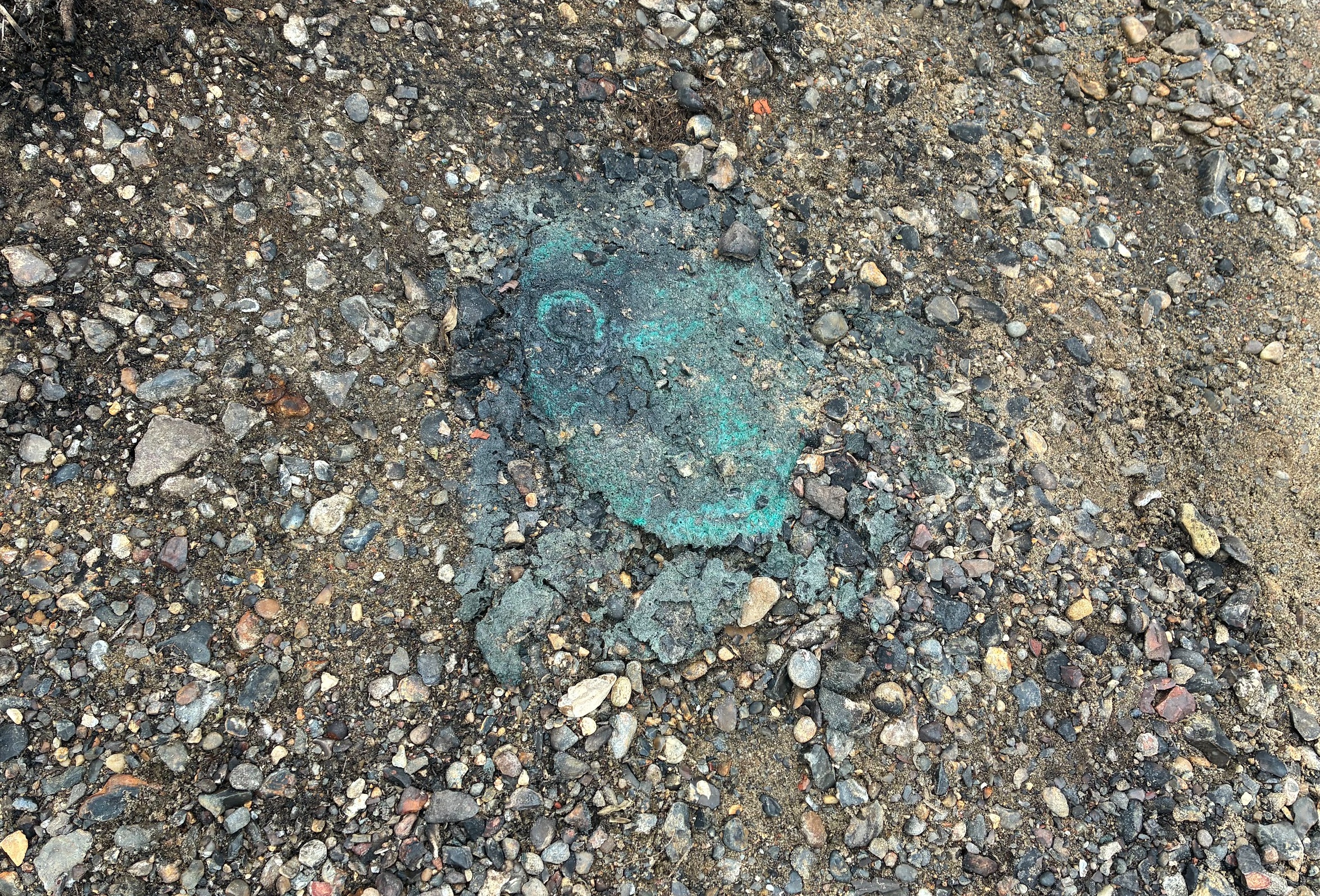
The melted 5-litre petrol container
We asked follow-up questions, and the Council’s tone changed completely
On 4 September, a further email to the Council put exactly those questions, along with a request for an update on the officer’s condition. That request was prompted by Cllr Smallwood’s public description of him being “absolutely fine and recovering well,” which sat awkwardly alongside independent information (from people connected to the volunteer network in the woods) that he had told colleagues he’d had an accident and cancelled his sessions until further notice, without giving a date for his return. The same email asked how the review mentioned a week earlier was progressing, and whether it was expected to produce findings the public would see.
The reply, again from Jordan Groves, was a different kind of document altogether. It said the incident remained “subject to an internal investigation and review,” and that as this process was ongoing, it would “not be appropriate to comment on the circumstances of the incident, potential causation, compliance with procedures, or any preliminary findings.” It cited a duty of confidentiality to decline any information about the officer’s “medical condition, injuries, absence from work, or any other personal employment matters.” It confirmed only that “appropriate action was taken” after the incident, and that “necessary interim measures” had been put in place regarding water quality and aeration, without saying what either of those things actually were. It made no commitment to publish the outcome of the review, only that the Council would “consider” sharing anything that “can properly be shared” once it concluded.
Compare that with the reply on 28 August, which freely described the circumstances of the incident and the sequence that led to the fire. A week later, the same office won’t discuss “circumstances,” “causation,” or “compliance with procedures“, categories that seem to cover much of what it had already told us. Jordan Groves is Head of the department in question, and was authorised to speak on both occasions. This isn’t a junior officer’s account being walked back by someone more senior. Something changed, in a week, about what the Council was prepared to say about the same incident: from a frank account of what happened, to a refusal to say whether its own safety procedures were followed.
Is fishing still “closed” at Ruislip Lido?
As part of the immediate response to the dead fish washing up on the shoreline at Ruislip Lido, fishing was promptly closed. We heard that both in the BBC News report – the journalist Matt Graveling said “Fishing has been temporarily stopped at the site” – and from Cllr Corthorne directly on Facebook (later quoted in the MyLondon and Uxbridge Gazette news reports) that councillors had been “advised the lake is now closed to fishing to preserve stocks”.
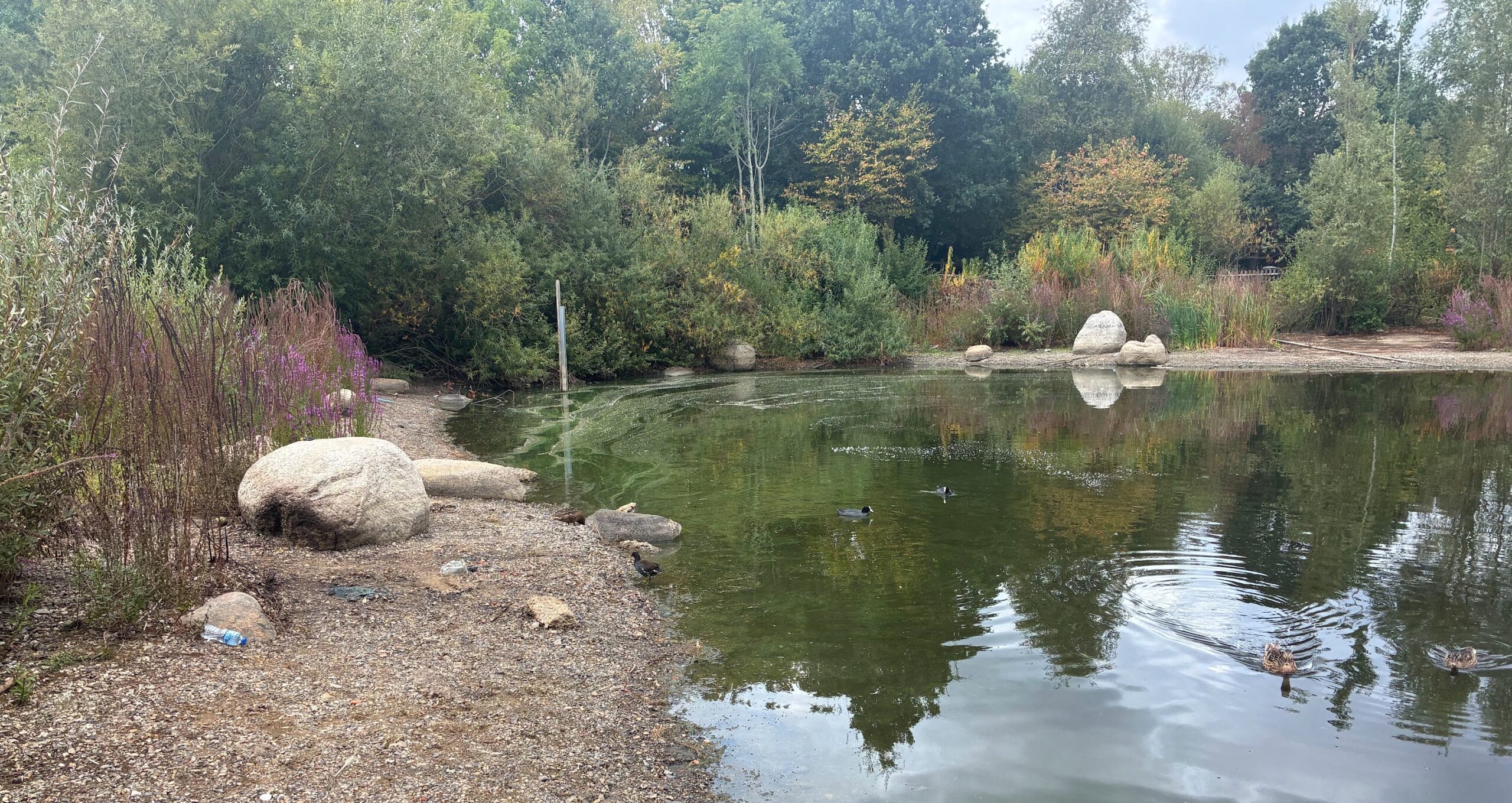
Is fishing still closed? How effectively was it ever closed? We have looked for signs, and there are none at the Lido itself – not along the dam wall, anywhere near the entrance, or in any of the noticeboards. “Do not enter the water” signs are few and far between, and not easy to find, or understand – but at least some of them exist in some places. “No fishing” signs though? We’re confident there are none. So, we were not surprised to see three fisherman on Sunday – even if we couldn’t work out quite how they got where they did!
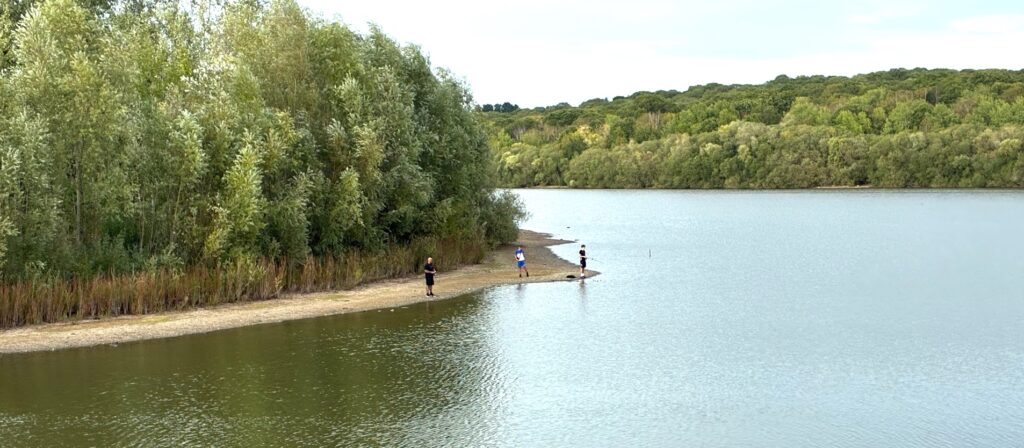
Three fishermen at the Lido on Sunday afternoon
What we’d like Hillingdon Council to explain
Four things, and none of them require the Council to pre-judge its own review or discuss anyone’s personal medical information:
- Whether the aeration units are treated as generators under the Council’s own Operational Safety Plan, and if so, whether a risk assessment was submitted and authorisation given for their use.
- Whether the Council’s own cooling-time and funnel guidance was built into how refuelling of this equipment was organised and supervised on the day, not to establish whether any individual made an error, but whether the systems and training around the task were adequate.
- Given that water quality at the Lido is already tested weekly, why aerators are only brought in as an emergency response once fish are dying, rather than being kept in place as a standing precaution.
- When the review will conclude, and whether its findings (beyond personal details already properly withheld) will be made public.
We’re not accusing the Council of anything here. We’d simply like it to follow its own safety plan, and not go quiet just as the questions start to matter, having had both officers and councillors speak about this incident candidly enough earlier on.


Comments are closed.