
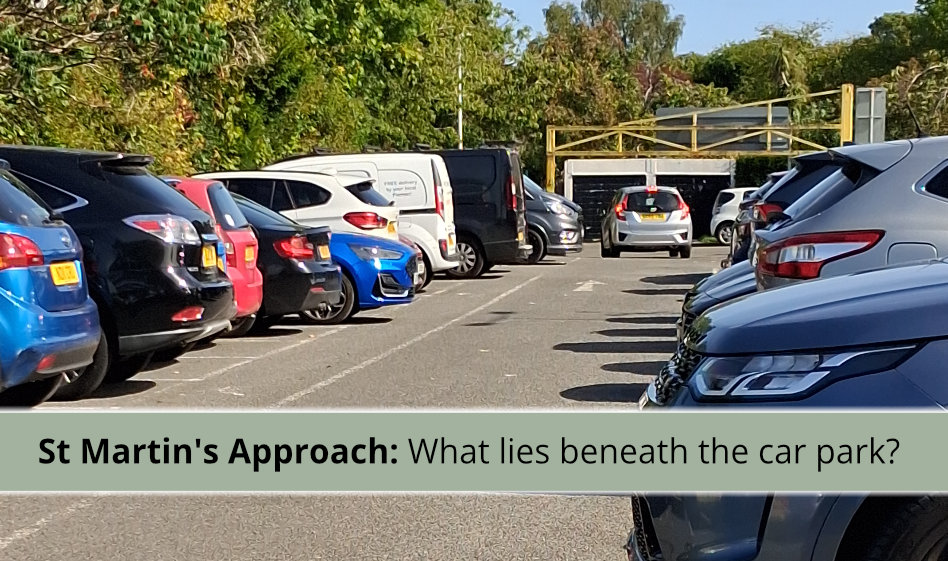
Many residents have asked why the planning application for six houses on part of the St Martin’s Approach car park has still not been determined.
The application has now been under consideration for many months and the target decision date shown on the Council’s planning portal has been pushed back several times. The most recently published date was 13 October, which has now passed without a decision.
One important reason for the delay appears to be archaeology
The proposed development site lies within the Ruislip Archaeological Priority Area and is located between two nationally important heritage assets: the Scheduled Medieval Motte and Moat site and the Church of St Martin of Tours.
In March 2026, the Greater London Archaeological Advisory Service (GLAAS), acting for Historic England, advised Hillingdon Council that further archaeological evaluation should be undertaken before any planning decision is made. GLAAS stated that trial trenching would be required because the site may contain archaeological remains associated with the medieval castle and priory and that these remains could potentially be of high significance. GLAAS further advised that, if the required archaeological information was not provided, the failure to submit it should be considered as a reason for refusing the application.
Following discussions with GLAAS, agreement has now been reached on the location and type of archaeological trenches to be dug.
Councillor Peter Smallwood recently advised that the Council is obtaining specialist quotations and considering traffic management arrangements before the work can proceed. Dates for the excavation have not yet been announced.
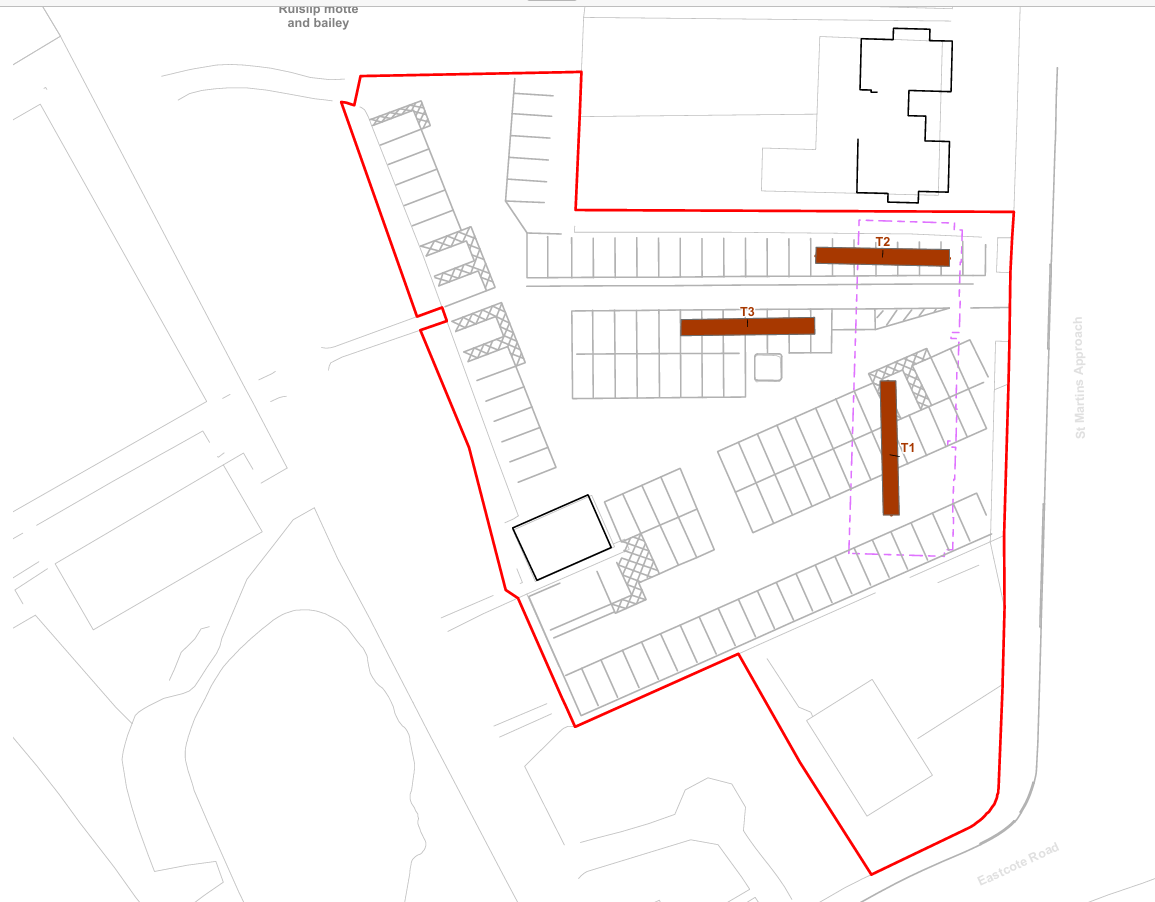
The three trench locations shown across St Martin’s Approach carpark – the dotted magenta lines mark the Council’s planned housing development area
RRA has also continued to raise concerns regarding other aspects of the proposal
These concerns include the adequacy of the parking surveys used to justify the loss of public parking spaces. We have questioned whether surveys undertaken at limited times accurately reflect the actual demand for parking throughout a typical year.
Particular concern has been expressed about the assumption in the applicant’s transport assessment that parking displaced from St Martin’s Approach can be accommodated within the Winston Churchill Hall car park. The proposal would reduce the number of spaces available within St Martin’s Approach by approximately 30%.
In our view, this assumption fails to reflect how the two facilities currently operate. When events are taking place at Winston Churchill Hall, parking demand generated by hall users can already exceed the capacity of its own car park, resulting in visitors parking in surrounding residential roads, including Pinn Way and nearby streets. It therefore appears unrealistic to assume that a reduced St Martin’s Approach car park could routinely rely upon Winston Churchill Hall for overflow parking at the same times that the hall is being actively used.
We have also highlighted that many users of St Martin’s Approach car park, including elderly and less mobile residents, may find it difficult to park further away and walk the additional distance from Winston Churchill Hall.
RRA has written to the Council on a number of occasions seeking clarification on these matters and continues to press for a planning decision to be based on a full and realistic assessment of parking demand, heritage impacts and the effect on the local community.
The archaeological investigations now appear to be a key stage in the determination process. Once trial trenching has been completed and the findings assessed by GLAAS and the Council, residents will have a clearer understanding of whether the proposal can proceed in its current form or whether further changes may be required.


Comments are closed.