Hillingdon Council has announced a crackdown on drivers who cross pavements and verges without an authorised dropped kerb. From November, persistent offenders face bollards or barriers blocking their access. We welcome the move. But having read the Council’s existing policy, we’re wondering quite how new this crackdown really is.
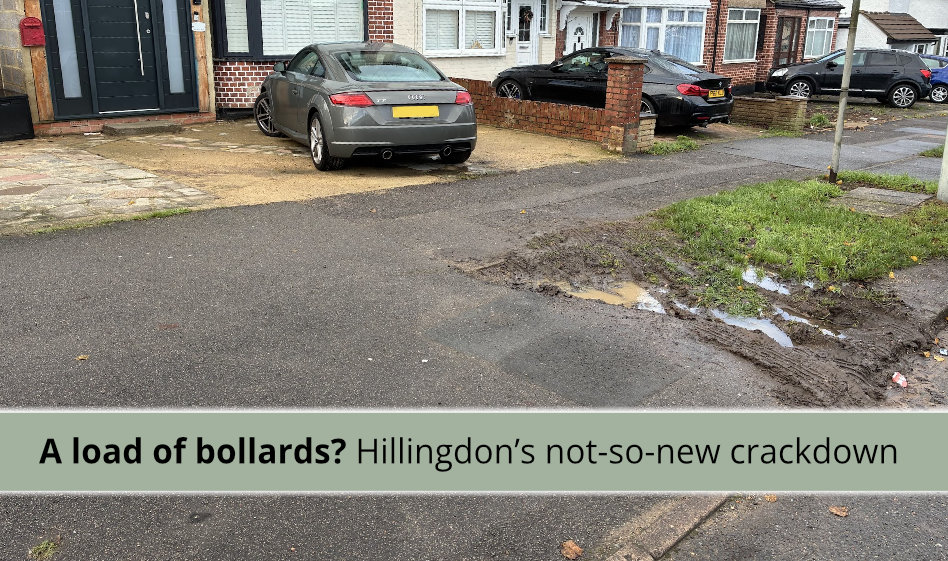
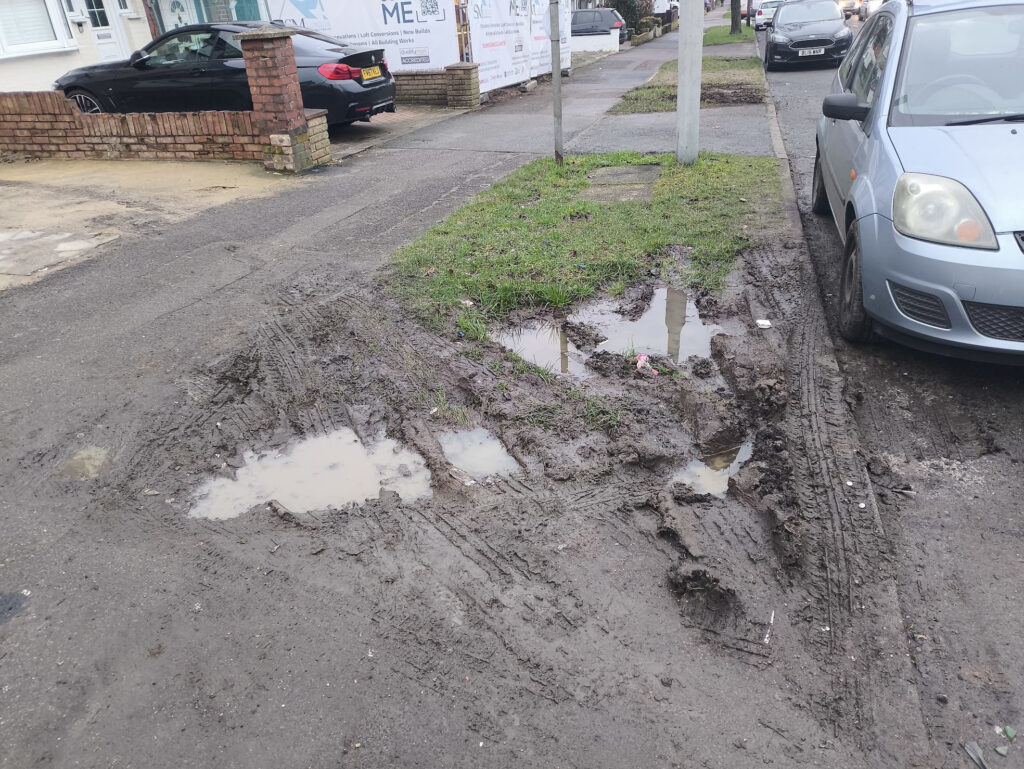
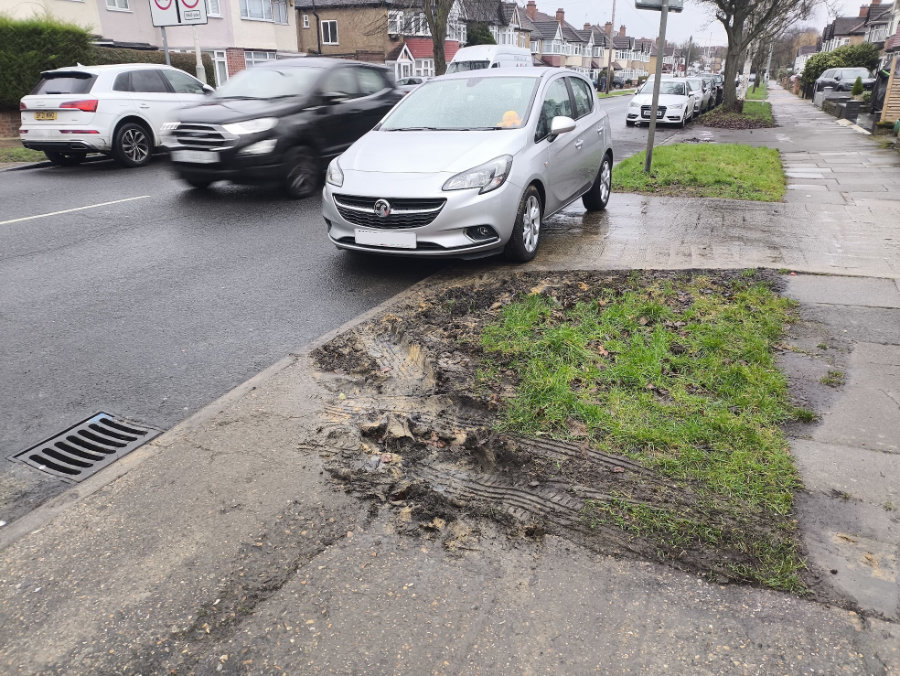
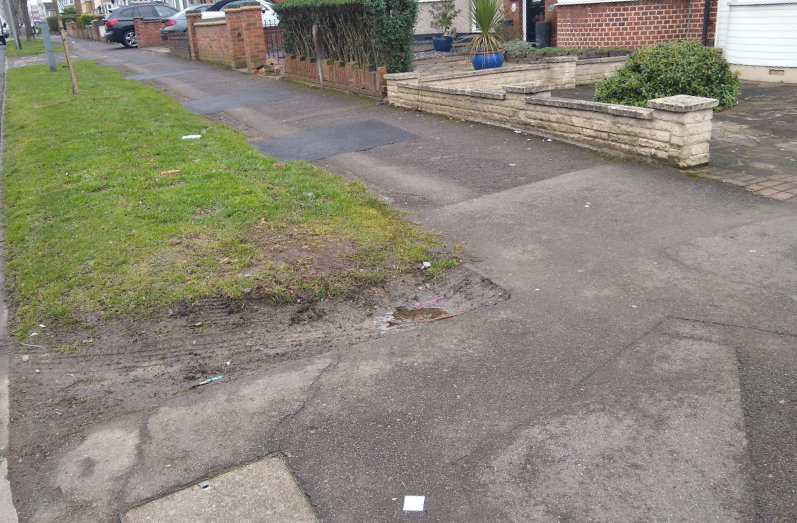
We’ve all seen the results of cars regularly crossing pavements and grass verges that weren’t designed for them: broken paving slabs, churned-up mud and damaged footways. They’re unsightly, potentially dangerous for pedestrians and expensive to repair.
So we’re pleased to see Hillingdon Council taking the problem seriously. Protecting our pavements is exactly the sort of thing we want the Council to do.
On 27 October, the Council announced that it would be taking “tougher action” against property owners who repeatedly drive across pavements without an authorised vehicle crossover, commonly known as a dropped kerb.
Bollards and barriers will be deployed. Warnings will be issued. The Council, it seems, means business.
Naturally, we wanted to find out more.
What is the Council proposing?
The new process, which begins in November, has three stages:
- An initial warning: The property owner receives a letter explaining the problem, what needs to be done and the consequences of ignoring it.
- A final warning: If the problem continues, a further letter gives 21 days to comply.
- Bollards or barriers: If the warnings are ignored, the Council can physically prevent vehicles crossing the pavement or verge.
Cllr Wayne Bridges, Cabinet Member for Residents’ Services, says the Council will use its legal powers to take tougher action against “those few who repeatedly ignore the rules“.
With more than 735 miles of pavement to maintain across Hillingdon, that’s a perfectly reasonable ambition.
There’s just one interesting detail….
It’s not new: The Council thought of this in 2022
Keen to understand the new approach, we looked up Hillingdon’s formal Domestic Vehicle Footway Crossover Policy.
It was approved by the Council’s Cabinet in July 2022 and came into force on 8 August that year.
Turn to section 5, on page 19, headed Illegal Crossing of Footways, and you’ll find something rather familiar.
The policy already says the Council may:
- Serve a formal Notice requiring unauthorised vehicle crossings to stop.
- If that Notice is ignored, inform the owner or occupier that it will install bollards or similar physical measures.
- Recover the full cost of repairs to damaged pavements, verges or roads from the property owner or occupier.
Section 3.2 also says that if someone applies for a dropped kerb and their previous unauthorised crossing has damaged the pavement or verge, the repair work will be included in the price quoted.
So the Council already had a published procedure for warning offenders, installing bollards and recovering repair costs more than four years ago.
The bollards, it turns out, have been waiting patiently in the policy since 2022.
So what’s actually changing?
That’s what we’d like to know.
The 2022 policy envisaged a formal Notice, followed by possible physical measures if it was ignored. The newly announced process specifies an initial warning, a final warning and a 21-day compliance period.
On paper, the most obvious change is a more clearly defined sequence of warning letters.
Perhaps the extra warning is intended to give residents a fairer opportunity to put things right. That’s no bad thing.
Perhaps the Council is now allocating more resources to investigating complaints and following through with enforcement. That would be welcome too.
Or perhaps this is largely a renewed commitment to use powers it already had.
The press release doesn’t really tell us.
There’s another interesting omission. Although Cllr Bridges rightly points out that damage to pavements costs taxpayers money, the announcement doesn’t mention the Council’s existing policy of recovering repair costs from those responsible.
The legislation underpinning the 2022 policy also provides for potential criminal penalties for knowingly breaching a statutory notice, and for recovering the reasonable cost of installing preventative measures. Neither gets a mention.
For a crackdown, the press release is surprisingly modest about some of the tougher powers already available.
A small legal mystery
One more detail is worth clearing up.
Section 5 of the Council’s 2022 policy cites two laws dealing with unauthorised vehicle crossings: the Highways Act 1980 and the London Local Authorities and Transport for London Act 2003.
The 2003 Act is particularly relevant. Section 16 was written specifically to address vehicles habitually crossing pavements and verges without an authorised crossover. It provides for formal notices, opportunities to object, appeal rights and, ultimately, physical measures to prevent further crossings.
Indeed, the Council’s current dropped kerb guidance still names both Acts when explaining its enforcement powers.
But the October press release cites the Highways Act 1980 and the Traffic Management Act 2004 instead.
Now, the 2004 Act does contain provisions about dropped kerbs. Section 86 deals with vehicles parked alongside them. But that’s rather different from driving across a pavement where there isn’t an authorised dropped kerb in the first place.
The legislation written specifically for the problem being tackled appears to have missed the launch of the crackdown.
There may be a perfectly straightforward explanation. A press release isn’t a legal textbook, and Councils have several powers available to them.
But it would be helpful to know why the announcement names the 2004 Act while omitting the 2003 legislation that the Council’s own policy relies upon.
It matters because, where the 2003 Act’s notice procedure is used, it provides at least 28 days to stop crossing, 21 days to object and, if an objection is rejected, a further opportunity to appeal to the county court.
How those safeguards fit with the newly announced 21-day final warning is something we hope the Council will explain.
Follow the money
There’s another question worth asking: who pays for all this?
Hillingdon’s financial difficulties are well documented. A May 2026 review by the Chartered Institute of Public Finance and Accountancy (CIPFA) recorded requests for £150 million of Exceptional Financial Support across two financial years. The Council received a government Best Value Notice in July, raising serious concerns about financial management and governance.
And on 22 October, just five days before the crackdown was announced, the Council’s Improvement and Assurance Board reported to Cabinet (agenda item 11) that Hillingdon still faced an underlying financial gap of approximately £50 million, with savings and income proposals of £30 million to £40 million under consideration.
The Board acknowledged progress, but called for more detailed testing of financial benefits, costs and risks.
So it’s fair to ask whether anyone has worked out what the crackdown will cost.
A properly authorised dropped kerb is largely paid for by the applicant. The Council charges for administration and construction, including necessary repairs to damage caused by previous unauthorised crossing. It does, however, take on responsibility for maintaining the completed crossover as part of the public highway.
Bollards are a different proposition.
The 2022 policy explicitly says the Council will recover the cost of highway repairs, but doesn’t say whether it also charges residents for installing bollards or barriers.
Interestingly, section 16 of the 2003 London Act — the legislation missing from the press release — allows Councils to recover the reasonable cost of preventative works carried out under its notice procedure.
So, in principle, the Council may be able to recover the cost of the bollards as well as the damage that led to them being installed.
But does Hillingdon actually send residents the bill? And, if it does, how much does it recover?
Those seem reasonable questions for a Council in its financial position.
They’re also relevant to the Council’s Cabinet Priorities 2026–2030, approved in September.
Under its promise to be “brilliant at the basics“, the Council commits to keeping roads and neighbourhoods clean, safe and well maintained, and taking tough enforcement action against those who harm communities.
The crackdown certainly fits those ambitions. The same priorities also emphasise financial resilience, and the Council has committed to aligning delivery with the resources available.
We support both objectives. We’d just like to see the sums.
After all, it’s possible that effective enforcement will save considerably more in future pavement repairs than it costs to carry out. That’s another good reason to measure the results.
What should you do if you receive a warning?
Whatever questions we might have about the announcement, the practical advice is straightforward.
- Don’t ignore the letter. The Council is signalling that it intends to follow through where unauthorised crossing continues. Check the deadline and what action is required.
- Check whether you can apply for a dropped kerb. Only the Council can arrange its construction, and the applicant normally pays. Approval is not automatic: the Council considers factors including available parking space, road safety, trees and grass verges. Applying does not itself authorise you to continue crossing.
- If you believe the warning is incorrect, respond promptly in writing. Ask the Council to explain the legal basis of the notice and any formal objection or appeal rights. Don’t assume that the 21 days mentioned in the press release is the only deadline that matters.
You can find the application details on the Council’s dropped kerbs website.
Let’s see what the crackdown achieves
We’re all in favour of enforcement that protects pavements, preserves grass verges and saves public money.
But a crackdown is ultimately measured by what happens on the ground, not by how firmly it’s announced.
So we’re preparing a Freedom of Information request asking the Council for figures for each year since its August 2022 policy came into force:
- Warnings and Notices: How many formal Notices has the Council issued to stop unauthorised vehicle crossings?
- Bollards and barriers: How many locations have had physical measures installed to prevent further crossing?
- Enforcement costs: What has the Council spent on repairing damage caused by unauthorised crossings and installing preventative measures? How much has it invoiced to property owners or occupiers for each, and how much has actually been recovered?
- Prosecutions: How many prosecutions have resulted from breaches of formal notices?
- Residents’ reports: How many reports or complaints about unauthorised crossings has the Council received?
- Dropped kerbs: How many applications has it received, approved and refused? What income has the service received in application, administration and construction charges, and what has it cost the Council to provide the service?
We’re also asking for the documents setting out the new two-warning procedure, which legal powers the Council intends to use, and how the process fits with statutory notice and appeal provisions.
And, given the Council’s financial position and its commitment to sound financial management, we’d like to see any costing, financial assessment or business case prepared for the new approach, including expected expenditure and cost recovery.
These figures should help answer three simple questions:
Has the Council been using the enforcement powers in its 2022 policy? What’s genuinely changing in November? And who will pay for it?
There may be perfectly good answers. Perhaps enforcement has been happening regularly but without much publicity. Perhaps the existing approach hasn’t worked as well as hoped. Or perhaps the Council has decided that the time has come to make greater use of its powers.
Any of those would be worth knowing.
We’ll publish the answers when we receive them. Then, in a year’s time, we’ll ask for the same figures again to see what has changed.
A welcome crackdown — if it delivers
We genuinely hope the new approach succeeds. Nobody benefits from broken pavements, damaged verges or unnecessary repair bills falling on taxpayers.
And if the Council is now going to make more effective use of powers it has held for years, that deserves support.
Its new priorities promise to be brilliant at the basics. Protecting pavements, enforcing the rules fairly and making sensible use of public money would be a good place to start.
We might just have preferred an announcement explaining what will actually change, rather than leaving residents to discover that the supposedly tough new measures were already sitting in the Council’s own policy.
We’re happy to applaud a crackdown. We’d just like to see the results before joining in the fanfare.
Has unauthorised vehicle crossing damaged a pavement or verge on your road? Let us know at secretary2@ruislipresidents.org.uk.


Comments are closed.