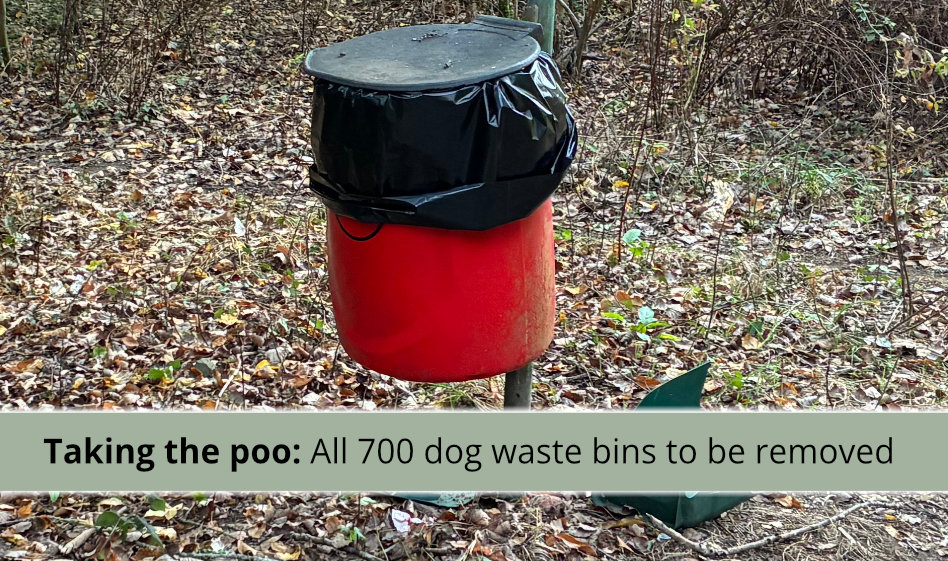
The dog waste bin on your regular walk could be gone by the end of January. The Council wants to remove all 700 of them and hasn’t asked residents what they think. Dog owners would be told to put their poo bags in ordinary litter bins, or take them home.
A report dated 14 October asks Cllr Wayne Bridges, Cabinet Member for Residents’ Services, to approve the removal of all 700 or so standalone dog waste bins in Hillingdon. Dog owners would be told to use ordinary litter bins or take the bag home.
It is a decision for Cllr Bridges alone, who can sign it off from Thursday 22nd October. The report says no formal public consultation has been carried out or is proposed. The Residents’ Services Select Committee can call the decision in before it takes effect, but only has five working days to do so.
What the Council wants to do
The dog bins cost about £160,000 a year to empty, under a contract with Charman Environmental Services Ltd. Ending that part of the contract produces the saving. The Council would put £60,000 a year back into street cleansing, leaving a net saving of about £100,000.
The 14½ tonnes of dog waste collected each month (about 174 tonnes a year) would move into the litter and household waste streams. The Council says its litter bins are “capable” of taking it.
Open - Payments to Charman Environmental Services
Payments to Charman Environmental Services Ltd
(only payments over £500 are listed)
Charman Environmental Services appears to have multiple contracts with Hillingdon Council, and has been paid over £240,000 between January and August 2026. They were awarded one contract for environmental cleaning for £339,000 in 2023. A similar sounding contract was renewed in June this year – but in an example of our Council’s opaque reporting and withholding of lots of detail, the June 2026 contract renewal was done in such secrecy that neither the company name nor the contract value was published in a heavily restricted report.
| Actual Payment Date | Account Description | Amount |
| 14/07/2026 | Private Contractors | £ 12,335.36 |
| 14/07/2026 | Private Contractors | £ 8,244.00 |
| 14/07/2026 | Private Contractors | £ 6,477.10 |
| 14/07/2026 | Building Cleaning | £ 5,033.00 |
| 14/07/2026 | Private Contractors | £ 2,817.00 |
| 14/07/2026 | Private Contractors | £ 2,430.00 |
| 14/07/2026 | Building Cleaning | £ 2,013.20 |
| 14/07/2026 | Private Contractors | £ 1,080.00 |
| 14/07/2026 | Private Contractors | £ 595.00 |
| 12/06/2026 | Private Contractors | £ 15,419.20 |
| 12/06/2026 | Private Contractors | £ 6,509.25 |
| 12/06/2026 | Building Cleaning | £ 6,291.25 |
| 12/06/2026 | Building Cleaning | £ 5,033.00 |
| 12/06/2026 | Private Contractors | £ 3,498.00 |
| 12/06/2026 | Private Contractors | £ 2,672.05 |
| 12/06/2026 | Private Contractors | £ 2,430.00 |
| 15/04/2026 | Private Contractors | £ 1,860.00 |
| 26/03/2026 | Private Contractors | £ 2,632.75 |
| 24/03/2026 | Private Contractors | £ 1,570.00 |
| 24/03/2026 | Private Contractors | £ 960.00 |
| 23/03/2026 | Private Contractors | £ 15,419.20 |
| 23/03/2026 | Private Contractors | £ 6,311.50 |
| 23/03/2026 | Building Cleaning | £ 6,291.25 |
| 23/03/2026 | Building Cleaning | £ 5,033.00 |
| 23/03/2026 | Private Contractors | £ 4,752.00 |
| 23/03/2026 | Private Contractors | £ 2,835.00 |
| 11/03/2026 | Professional Training | £ 4,410.00 |
| 06/03/2026 | Private Contractors | £ 12,335.36 |
| 06/03/2026 | Building Cleaning | £ 5,033.00 |
| 06/03/2026 | Building Cleaning | £ 4,026.40 |
| 04/03/2026 | Private Contractors | £ 6,848.75 |
| 04/03/2026 | Private Contractors | £ 2,725.00 |
| 23/02/2026 | Private Contractors | £ 4,020.00 |
| 12/02/2026 | Private Contractors | £ 2,716.70 |
| 06/02/2026 | Private Contractors | £ 12,335.36 |
| 06/02/2026 | Building Cleaning | £ 5,033.00 |
| 06/02/2026 | Building Cleaning | £ 4,026.40 |
| 03/02/2026 | Professional Training | £ 4,410.00 |
| 27/01/2026 | Private Contractors | £ 7,524.00 |
| 27/01/2026 | Private Contractors | £ 6,455.55 |
| 22/01/2026 | Private Contractors | £ 3,169.65 |
| 07/01/2026 | Private Contractors | £ 12,335.36 |
| 07/01/2026 | Private Contractors | £ 6,252.30 |
| 07/01/2026 | Building Cleaning | £ 5,033.00 |
| 07/01/2026 | Building Cleaning | £ 5,033.00 |
If Cllr Bridges signs on 22nd October, stickers reading “I can take dog waste too” could start appearing on selected litter bins from mid-November, and the dog waste bins could start to disappear from late January.
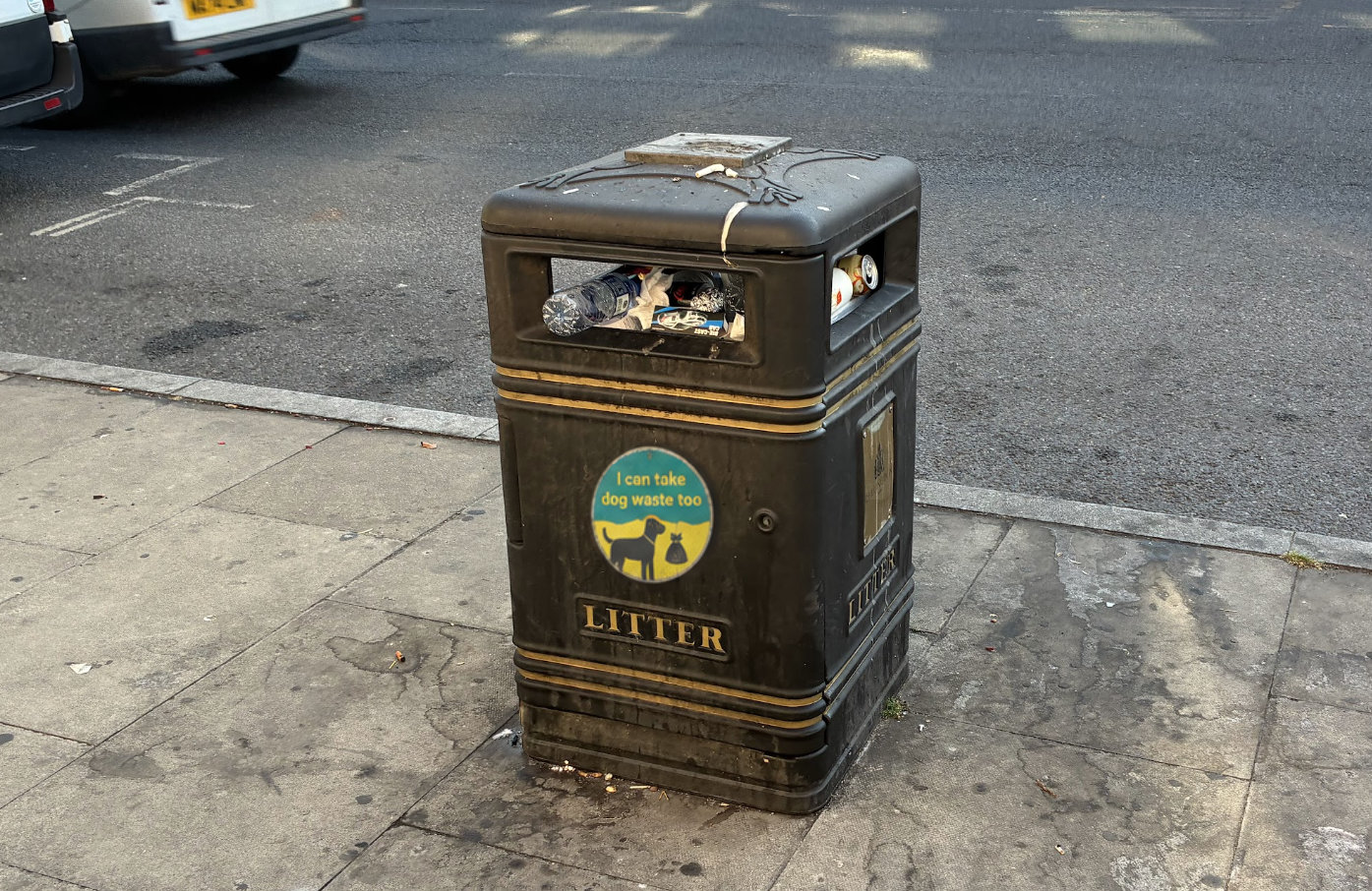
“I can take dog waste too” sticker on a bin… good luck with that on the full bins in Ruislip Manor!
The Council explains that it has no legal duty to provide dog waste bins, and that dog waste can legally go in a litter bin. Two bins side by side may well be one too many. The question is whether that is true of all 700.
Duplication, but not the kind the report means
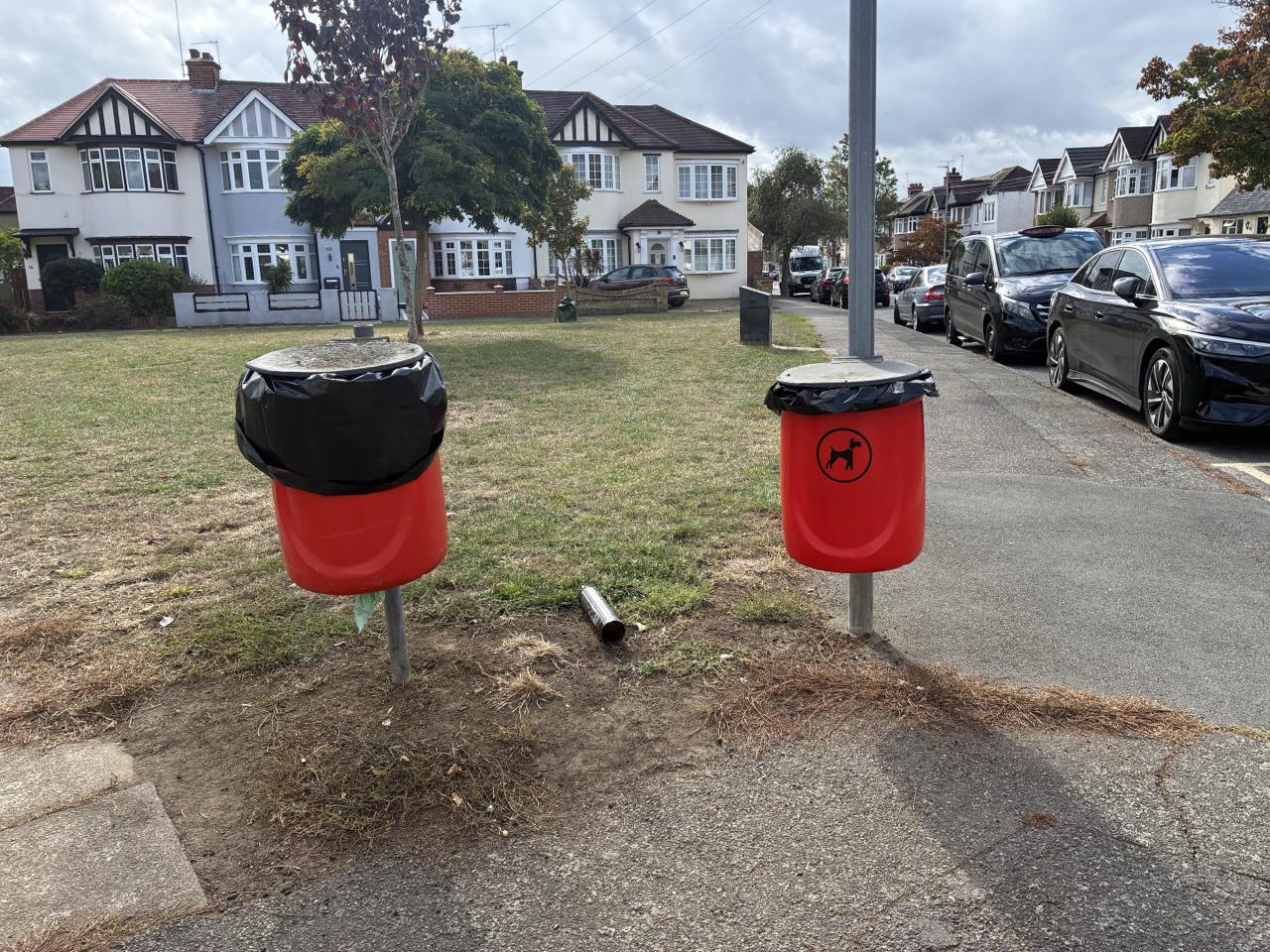
The report says many dog bins sit close to litter bins, and that removing the duplication is part of the point. These two places in Ruislip and Ruislip Manor have duplication of a different kind: two dog waste bins side by side.
-

- Two dog waste bins together in Ruislip Manor
-
- Two dog waste bins together at Ruislip Lido
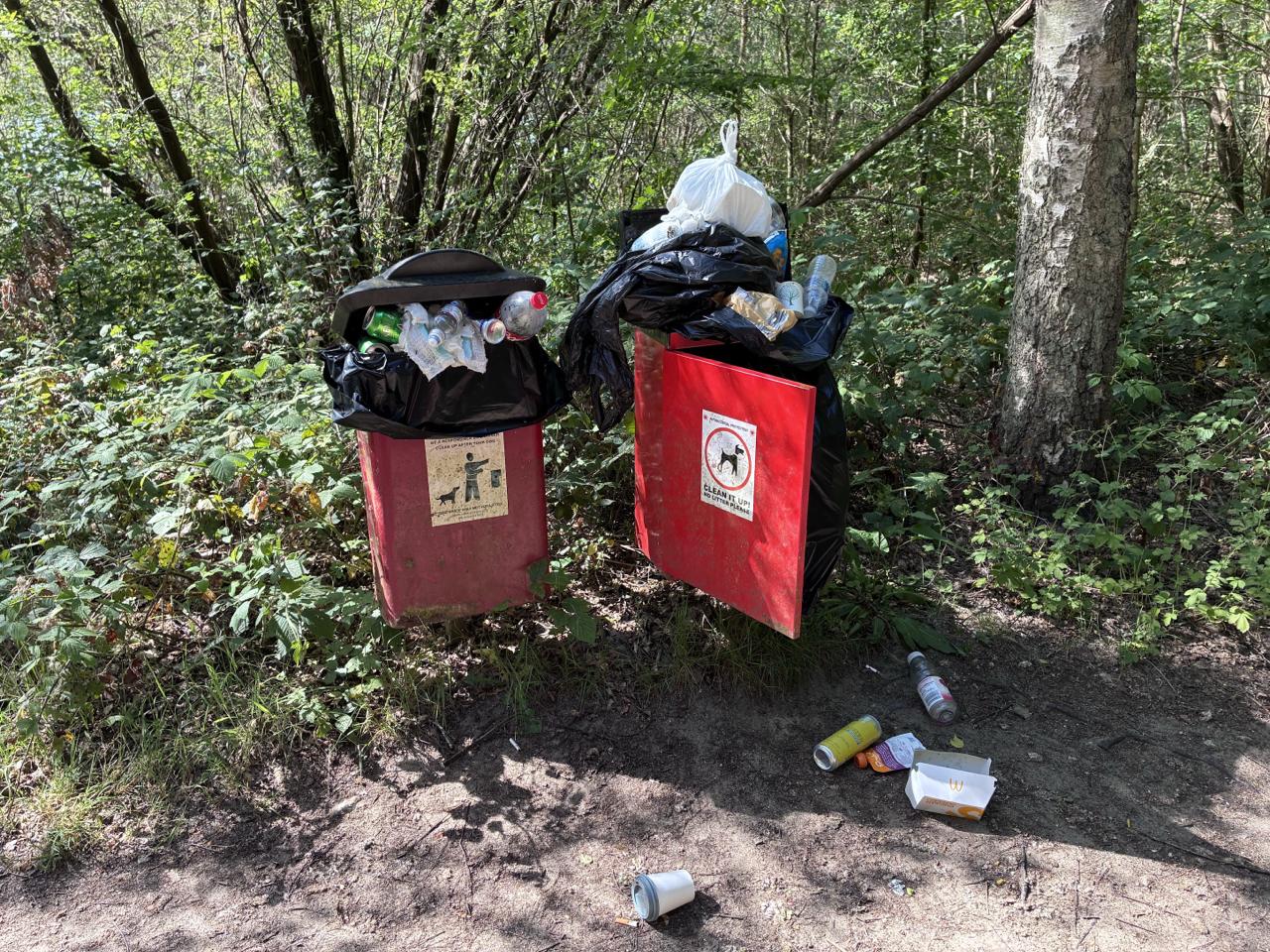
That isn’t the duplication the report is describing. But it shows the same thing the report admits: a network that grew “incrementally” rather than through a “strategic assessment of operational need”. If we can find examples like these, the 700 bins have clearly not been placed or reviewed with much care. That is a case for sorting them out bin by bin, not for removing all of them. The report considered that approach as Option 2, and rejected it because it would still need a dedicated collection service.
The wider picture: counting in RAGCs
Hillingdon’s finances have been the backdrop to everything this year. CIPFA’s independent review found a council reliant on Exceptional Financial Support and borrowing, and a government Best Value Notice in July cited its lack of “organisational grip”. Every saving counts, and we accept that.
It also helps to see the scale. At the RRA we measure council savings in RAGCs. One RAGC is £150,000, named after the Rural Activities Garden Centre the Council closed last year. CIPFA puts the Council’s underlying budget gap at £48.3 million for 2027-28, which is 322 RAGCs.
The dog bin proposal saves about two-thirds of an RAGC after reinvestment, leaving roughly 321 to go.
Part of the explanation is a decision taken a decade ago. Hillingdon didn’t increase council tax at all for ten years, from 2009-10 to 2018-19. That was a choice made by Ray Puddifoot and his Conservative administration, and supported at the time by some of those still in the administration today. CIPFA found that Band D council tax has gone from £6 below the outer London average in 2010-11 to £234 below it now, about 15% lower. Bringing it up to that average would raise around £26.6 million a year, roughly 177 RAGCs.
We aren’t arguing here for or against a council tax rise. CIPFA is clear that Hillingdon is otherwise a low-cost council, one that “is unlikely to be able to meet the budget gap by efficiency savings alone”. Its benchmarking rates Hillingdon’s environmental and regulatory services spending as “very low” against other London boroughs, so there isn’t much fat left to trim.
CIPFA said Hillingdon’s officers had already drawn up a list of hard choices, but found “no political will” to take them: fortnightly bin collections, a review of the libraries and the three theatres, and a council tax rise above the referendum limit. None of those is in this report. This is just a £100,000 saving the Council can make on its own, without asking anyone.
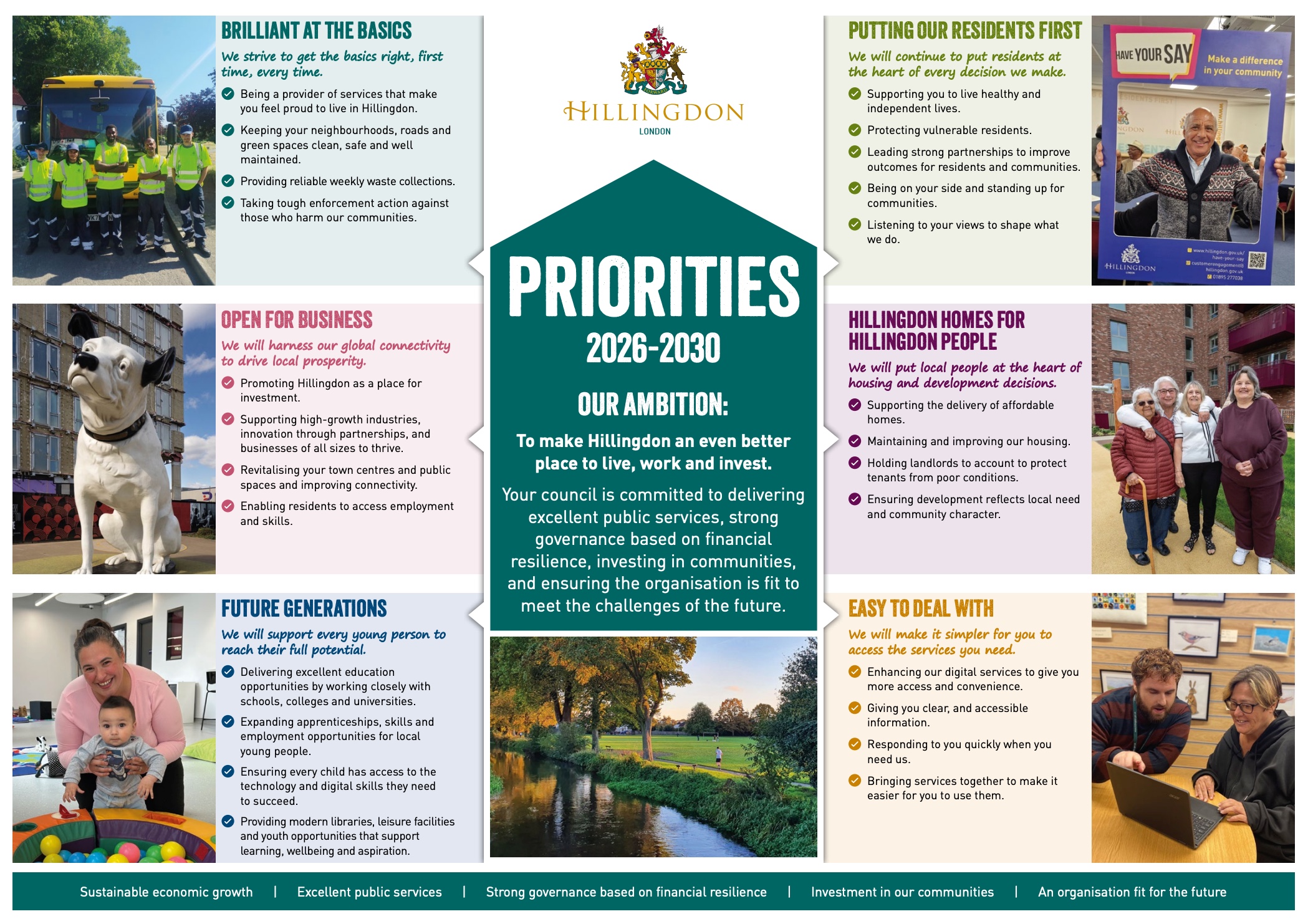
Hillingdon Council’s Priorities for 2026-2030
“Brilliant at the basics”?
Cabinet has just adopted its priorities for 2026–2030. Under “Brilliant at the basics” the Council promises to keep “neighbourhoods, roads and green spaces clean, safe and well maintained”, and to take “tough enforcement action against those who harm our communities”. Under “Putting our residents first” it promises “listening to your views to shape what we do”. Under “Easy to deal with” it promises “responding to you quickly when you need us.”
How would you judge this proposal against those promises?
What we’ve seen on the ground
The report assumes the existing litter bin network will absorb the extra waste. We have been looking at it.
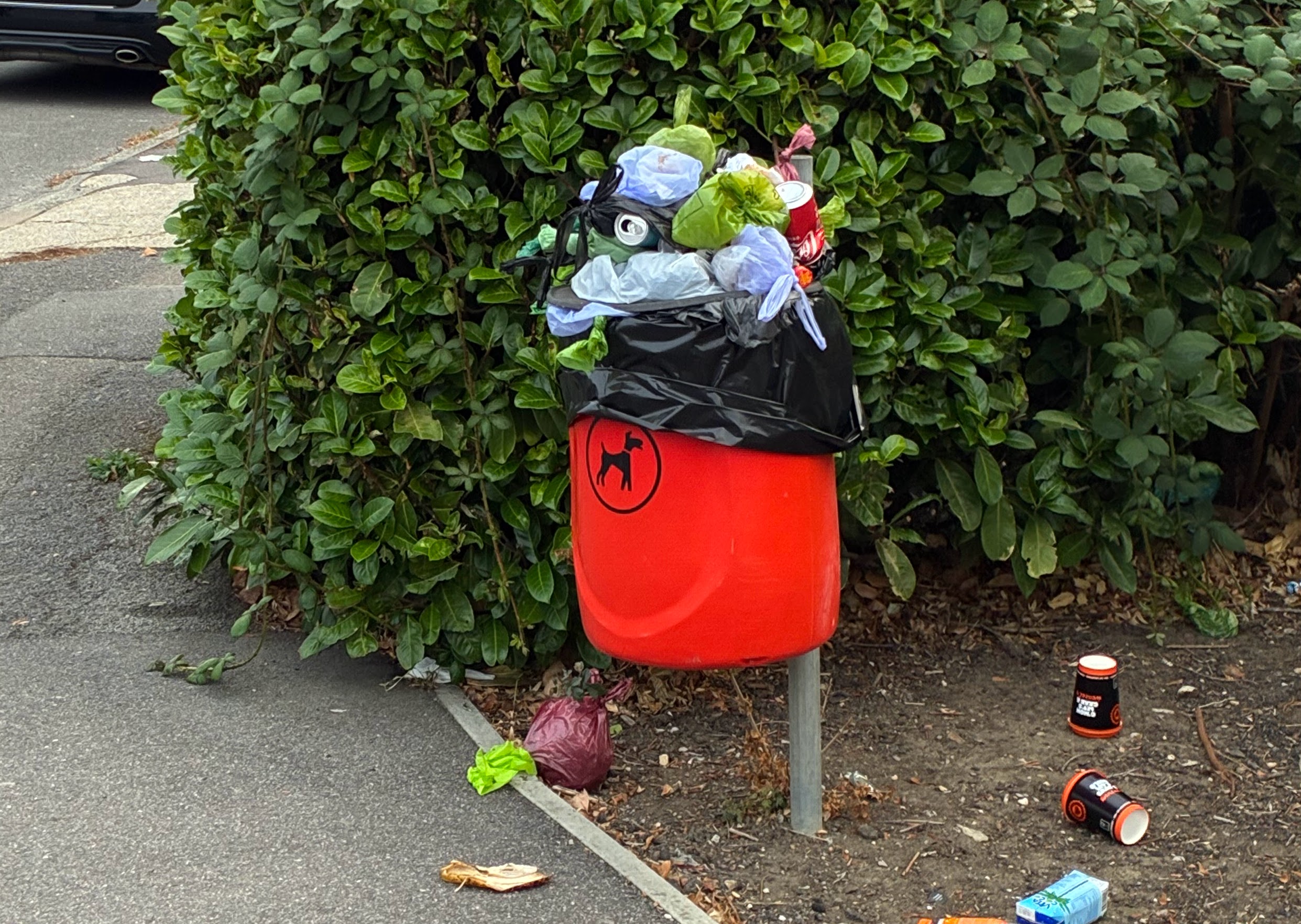
Dog waste bin in Ruislip Manor. Full and spilling over, with no litter bin nearby.
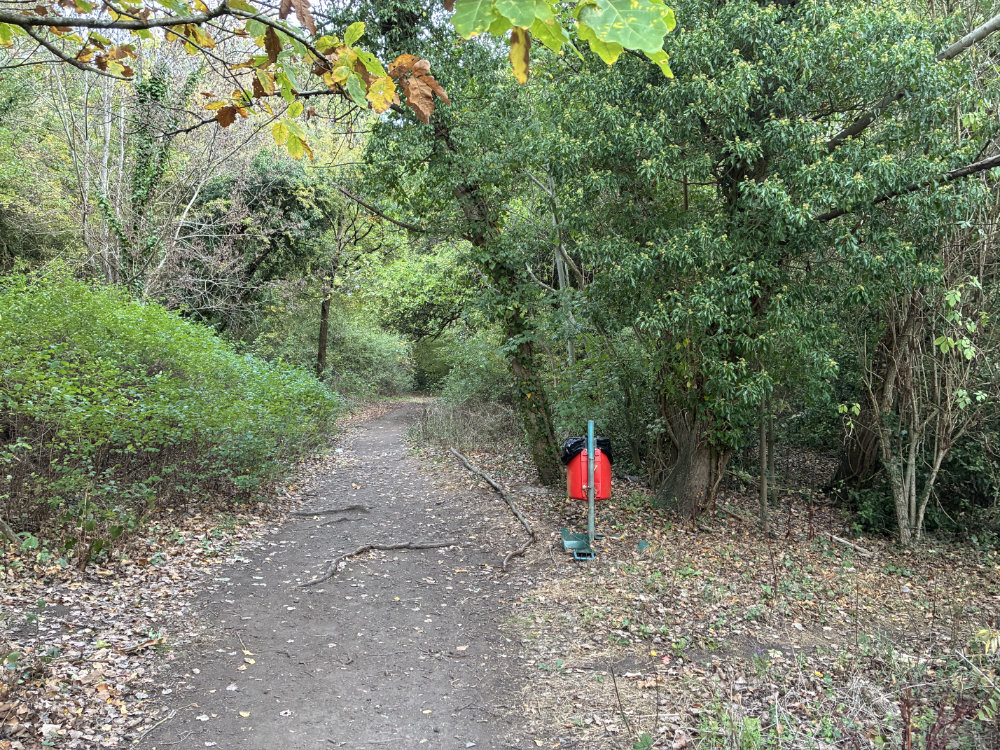
Dog waste bin in Ruislip Woods National Nature Reserve. There is no nearby litter bin.
Some of these bins are already overflowing under the current dedicated service. The Council asks residents to report problems through the Love Clean Streets app. In our experience, reports of overfilled dog waste bins are closed almost immediately with a reply that the bin will be emptied within the next five days anyway. That suggests the bins are well used and can fill up between collections.
If bins dedicated to dog waste overflow within a five-day cycle, how will ordinary litter bins cope with an extra 174 tonnes of dog poo a year, when on many streets there isn’t one to cope?
Our concern: poo on the pavement, and a “poo Christmas tree”
Where there is no litter bin close by, some owners will carry the bag home. Others will not. We think more dog poo will be left on the pavement. The Council seems to expect the same. Why else would it be keeping back £60,000 a year of the saving for street cleansing?
We can also imagine bags of dog poo tied to bushes and shrubs along the walks where the bins used to be, until they look like a poo Christmas tree. Dedicated dog bins exist largely because many owners didn’t take the bag home, and the report offers no evidence that this has changed.
The report itself lists “an increase in dog fouling” as a main risk. But it treats it as a risk that comes from residents being “unaware” of the alternatives, to be fixed with signs and stickers. It doesn’t consider the case where the alternative is a long walk away, or doesn’t exist.
What else the report doesn’t say
- Which bins will go. The summary says “many” dog bins are close to litter bins, and a later section says “the majority” are in areas with alternatives. That implies some aren’t, yet all will be removed. There is no list or map, and no plan to put litter bins where dog bins are the only bin.
- What the £60,000 covers. One recommendation says it is for litter bin servicing “and associated waste disposal costs”, while the financial section says disposal costs will be “absorbed” into an existing budget.
- The evidence. The decision rests on a “comprehensive review”, but the list of background papers says “NIL”. The “many other local authorities” that have done the same aren’t named.
No consultation
The Council says this is “a change in the method of collection rather than the withdrawal of a service”, so formal consultation isn’t “necessary or proportionate”. Many dog walkers will see it differently when the bin they use every day disappears.
The parking changes we reported last month are also about £160,000 a year of savings (saving another “RAGC”), and they are going to a 21-day consultation. This decision was published on the Cabinet Member Decisions page, where few residents will look. The report’s answer to public concern is a communications plan explaining “the financial benefits to the Council”. Residents will be told rather than asked.
What happens next
Cllr Bridges can take the decision from 22nd October. Once it is published, the Residents’ Services Select Committee has five working days to “call it in”, counted from 5pm on the day of publication. Call-in lets the committee ask for the decision to be reconsidered before it takes effect. If it isn’t called in, the stickers and then the bin removals follow.
In its review, CIPFA found a lack of depth in the Council’s scrutiny, and the Best Value Notice expects scrutiny that works. This is a chance to show it can.
The committee’s members are:
- Cllr Peter Smallwood (Chair), Ruislip
- Cllr Daniel Singham, Eastcote
- Cllr Tommy Balaam, Harefield Village
- Cllr Riley Russell, Uxbridge
- Cllr Navnit Dhesi, Hayes Town
- Cllr Kamal Preet Kaur, Wood End
- Cllr Paul Capps, West Drayton
Every member has received the report, and the window is short. If a dog waste bin matters on your road, in your park or on your regular walk, tell your ward councillors, Cllr Bridges and the committee members now. We’d also like to hear from you and we’ll share in a future update what we receive. If you email your ward councillors or Cllr Bridges, please copy us in – secretary2@ruislipresidents.org.uk.

Comments are closed.